

What if the recent changes in your body aren’t a sign of “failed” willpower, but a complex biological shift trying to tell you something important? Many people in British Columbia and Alberta feel a deep sense of shame when they notice a shift in their waistline or receive a confusing diagnosis from their doctor. It’s common to feel overwhelmed by the link between Metabolic X and weight gain, especially when traditional advice often focuses on restriction. You deserve to know that these changes are not your fault; they are part of a recognized cluster of metabolic shifts that over 26% of Canadian adults are currently managing.
We understand the fear that comes with a potential diagnosis or the frustration of “failed” diets that leave you feeling depleted. That’s why we’re here to provide a different perspective. This article promises to help you understand the specific 3-out-of-5 diagnostic criteria used by healthcare teams and discover a weight-inclusive path to health. We’ll preview sustainable ways to manage your blood sugar and cholesterol through flexible nourishment, moving away from the “all-or-nothing” mindset and toward a sense of peace and vitality.
Key Takeaways
- Learn about the five specific health markers and the “3-out-of-5” rule used by healthcare providers to identify metabolic shifts.
- Understand the biological connection between Metabolic X and weight gain, specifically how insulin resistance can influence energy storage.
- Shift your focus from restrictive dieting to nourishment by adopting an “Add, Don’t Subtract” philosophy for metabolic support.
- Discover how balanced meal structures and food flexibility can help stabilize blood sugar and cholesterol levels while restoring your quality of life.
- Explore how working with a Registered Dietitian for medical nutrition therapy can provide a personalized, shame-free path to managing your health markers.
What is Metabolic Syndrome X and How is it Diagnosed?
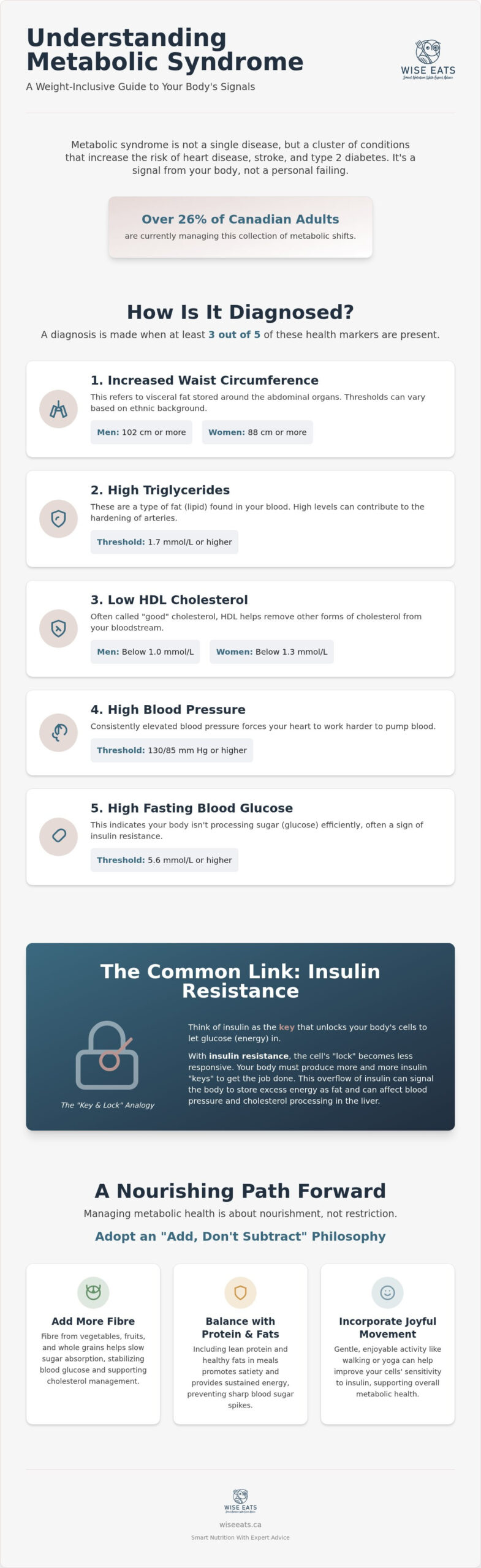
Have you ever felt like your body is speaking a language you don’t quite understand? When we talk about What is Metabolic Syndrome?, we’re looking at a collection of metabolic shifts rather than one isolated issue. Often called “Syndrome X” or “Insulin Resistance Syndrome,” this condition is diagnosed when at least three out of five specific health markers fall outside the standard range. It’s helpful to view these markers as a dashboard for your body. They provide clues about how your system is processing energy and managing stress. Understanding the link between Metabolic X and weight gain starts with looking at these five clinical indicators as a whole, rather than focusing on any single measurement in isolation.
The Five Key Clinical Markers
In a clinical setting in Alberta or British Columbia, your healthcare team uses specific thresholds to assess your metabolic health. These criteria include blood pressure of 130/85 mm Hg or higher and fasting blood glucose levels of 5.6 mmol/L or higher. Your team also looks at triglycerides (1.7 mmol/L or higher) and HDL “good” cholesterol (below 1.0 mmol/L for men or 1.3 mmol/L for women). Finally, abdominal circumference is measured, with thresholds of 102 cm or more for men and 88 cm or more for women, though these can vary based on ethnic background. These numbers are just data points. They don’t define your worth or your future health.
Why Do These Conditions Cluster Together?
Why does one health shift often invite others to the party? Often, the root of this cluster is insulin resistance. When your cells don’t respond effectively to insulin, your body compensates by making more of it. This process can ripple through your system, affecting your blood pressure and how your liver processes fats. Your genetics and personal health history play significant roles here. You might find that your body is naturally predisposed to these shifts. Regular lab work with your Canadian healthcare team is essential for clarity. Working with a professional through medical nutrition therapy can help you make sense of these results. We can explore how the connection between Metabolic X and weight gain is influenced by your unique history and find a supportive path forward together.
The Link Between Metabolic Syndrome X and Weight Gain
It can feel incredibly frustrating to notice changes in your body when your habits haven’t shifted. You might be wondering why your clothes fit differently or why your energy levels feel low. The connection between Metabolic X and weight gain is complex. It’s often a cycle where metabolic shifts lead to weight changes, which then influence your metabolic markers further. Weight is just one piece of a much larger puzzle. It’s a signal from your body, not the whole story of your health.
Understanding Insulin Resistance
To understand this link, we can use a “key and lock” analogy. Imagine your cells have a lock that needs to be opened to let glucose, or energy, inside. Insulin is the key that opens that lock. When insulin resistance occurs, the lock becomes “rusty” or jammed. Your body tries to fix this by making even more keys (insulin). These high levels of insulin can sometimes tell your body to store excess energy as fat rather than using it for fuel. This process can make you feel tired and more prone to storing energy, regardless of your activity level.
The Myth of the “Apple” vs. “Pear” Shape
Clinicians often focus on “visceral fat,” which is weight carried around the abdominal organs. This specific type of fat is highly metabolically active. It can release hormones that affect how your body manages blood pressure and cholesterol, contributing to the risk factors for cardiovascular disease. While this information helps your healthcare team understand your internal environment, it shouldn’t be used to shame you. Body diversity is a natural part of being human. Your shape is a reflection of your biology and genetics, not a measure of your self-discipline. If you’re looking for a non-judgmental space to discuss these changes, you can book a supportive consultation with us to find a path that feels right for you.
Managing Metabolic Health Without Restrictive Dieting
Managing metabolic health doesn’t have to mean living in a state of deprivation. For many people dealing with the intersection of Metabolic X and weight gain, restrictive dieting can actually backfire by increasing stress and triggering biological survival mechanisms. We prefer an “Add, Don’t Subtract” philosophy. This approach focuses on what you can include to support your body’s systems. Instead of cutting out your favourite foods, we look at adding fibre from colourful vegetables, healthy fats, and adequate protein to help stabilize your energy levels throughout the day.
Fibre is a powerhouse for managing cholesterol and glucose. It slows down the absorption of sugar, which prevents the sharp insulin spikes that can contribute to metabolic shifts. Adding gentle movement that you actually enjoy, like a walk through a local park or a restorative yoga session, can also help your cells respond better to insulin without movement feeling like a punishment. Understanding the causes of metabolic syndrome helps us see that support is about lifestyle integration, not rigid rules.
Nourishing Your Body for Stability
One of the most effective ways to support your metabolism is through balanced meal structure. By pairing proteins with complex carbohydrates, you create a steady release of energy. This prevents the “crashes” that often lead to intense cravings or fatigue. We focus on identifying bioavailable nutrients within a Canadian diet, such as local pulses, grains, and seasonal produce. You can use our Ultimate Nutrition Guide to help you plan meals that feel satisfying and nourishing while supporting your metabolic markers.
Restoring Your Relationship with Food
Many of our clients in Alberta and British Columbia come to us after years of frustration. It’s essential to understand why diets fail long term; they often ignore the body’s need for safety and consistency. Chronic stress and high cortisol levels can negatively impact your metabolic markers just as much as what you eat. By moving toward food neutrality and treating all foods as morally equal, you can lower your stress levels and reconnect with your body’s natural cues. This shift is a vital part of managing the interplay between Metabolic X and weight gain without the shame often associated with traditional medical advice.
A Personalized Approach: Working with a Canadian Dietitian
Navigating the intersection of Metabolic X and weight gain can feel like trying to solve a complex puzzle without having all the pieces in front of you. While general nutrition education is a helpful starting point, your body’s specific response to insulin and glucose is unique to your genetics and history. This is where medical nutrition therapy becomes a vital tool. Rather than providing a generic list of “dos and don’ts,” a Registered Dietitian works with you to translate your lab results into a practical, flexible way of eating. We look at your nutritional needs through a clear lens, ensuring you feel energized rather than restricted.
Your journey is most effective when it’s a team effort. We encourage a collaborative approach that involves your family doctor or GP alongside your dietitian. While your doctor monitors your clinical markers, we provide the day-to-day “how-to” for managing those markers through nourishment. A custom meal plan isn’t about rigid rules; it’s about providing a clearer picture of how different foods can help stabilize your blood sugar and support your long-term vitality. It’s about finding what works for your life in British Columbia or Alberta, from your favourite local grocery stores to your busy family schedule.
Custom Vitamin and Mineral Support
Sometimes, even a balanced diet needs a little extra support to address specific metabolic markers like high triglycerides or fasting glucose. This is why we offer personalized supplements through our partnership with VitaminLab. Unlike “one-size-fits-all” multivitamins found on pharmacy shelves, these are hand-crafted formulas based on your unique blood work and health data. Having a bespoke formula means you aren’t taking unnecessary fillers. Instead, you’re getting the exact nutrients your body may need to support metabolic stability and improve your overall quality of life.
When to Seek Help
Sometimes, the physical or emotional toll of managing your health can feel overwhelming. It’s helpful to watch for signals that your body or relationship with food may need extra care. We recommend reaching out to your healthcare team if you notice red flags such as persistent fatigue that doesn’t improve with rest, occasional blurred vision, or frequent thirst. Additionally, if you find yourself feeling “out of control” or anxious around food, or if the stress of Metabolic X and weight gain is impacting your daily mood, booking a supportive conversation can offer relief.
You don’t have to navigate these changes alone. You can find a weight-inclusive dietitian on our team who understands the importance of shame-free care. Whether you choose to work with Rachel McBryan in BC or Sheirry Poposka in Alberta, we are here to provide a steady hand and evidence-based guidance as you restore your zest for life.
Your Path to Sustainable Metabolic Health
You’ve learned that your health is defined by much more than just a single number on a scale. By understanding the specific clinical markers used for diagnosis, you can move away from the frustration of body changes and toward a clearer picture of your internal well-being. We’ve explored how the biological connection between Metabolic X and weight gain is influenced by insulin sensitivity, and how an “Add, Don’t Subtract” philosophy can restore your energy without the need for restrictive dieting.
Our Registered Dietitians, licensed in British Columbia and Alberta, are here to support you with an evidence-based, non-diet approach. Whether it’s through custom meal planning or integrating hand-crafted VitaminLab supplements based on your unique lab data, we can help you find a path that feels both manageable and empowering. You deserve a healthcare partner who listens without judgment and focuses on your quality of life. It’s time to replace anxiety with clarity and hope.
We’re in this together. We can’t wait to help you rediscover your zest for life and find a rhythm of nourishment that truly works for your body.
Frequently Asked Questions
Is Metabolic Syndrome X the same as being pre-diabetic?
Metabolic Syndrome X is a cluster of five specific health markers, while pre-diabetes refers specifically to elevated blood sugar levels. While high fasting glucose (5.6 mmol/L or higher) is one of the criteria for Metabolic Syndrome, they aren’t the same thing. You can have the syndrome without being pre-diabetic, although the two conditions often overlap. Both are helpful signals that your body needs a more personalized approach to energy management.
Can I manage Metabolic Syndrome without focusing on weight loss?
You can absolutely focus on health-promoting behaviours without making weight loss your primary goal. Improving your metabolic markers, such as blood pressure and cholesterol, is possible through consistent nourishment and gentle movement. This weight-inclusive approach helps lower the stress of “failed” diets and focuses on restoring your quality of life. By stabilizing your blood sugar, you support your body’s health regardless of your size or shape.
Why am I gaining weight specifically in my midsection?
Midsection weight gain is often a biological marker of insulin resistance rather than a simple lifestyle issue. When your cells stop responding to insulin effectively, your body may store excess glucose as fat around your internal organs. This process is complex and often linked to the interplay between Metabolic X and weight gain. It is a physiological shift that requires compassionate management, not a reason for personal shame or restriction.
How much fibre do I actually need to improve my cholesterol?
Aiming for 25 to 38 grams of fibre daily is a helpful target for most Canadian adults to support cholesterol levels. Soluble fibre is especially effective because it can help “soak up” cholesterol in the digestive system. You can find this in everyday foods like oats, lentils, and apples. We recommend increasing your fibre intake slowly and drinking plenty of water to help your digestion stay comfortable as you add these nourishing options.
Are personalized vitamins worth it for metabolic health?
Bespoke vitamins can be very effective when they are tailored to your specific lab markers and nutritional gaps. A generic multivitamin might not contain the right balance of nutrients to support your unique glucose or triglyceride levels. By using a data-driven formula from VitaminLab, we can target the exact markers identified by your healthcare team. This personalized support helps bridge the gap between your daily intake and your body’s metabolic needs.
What are the first steps to take after a Metabolic Syndrome diagnosis?
The first step is to assemble a supportive team that includes your GP and a Registered Dietitian to help you navigate the Metabolic X and weight gain connection. Together, you can review your lab work and identify which of the 3-out-of-5 diagnostic criteria are present. We then focus on “adding” nourishment to your day, like fibre and protein, rather than focusing on restrictive rules that can increase your stress and cortisol levels.

Article by
Rachel McBryan, Dietitian
Rachel McBryan is a licenced Dietitian in British Columbia offering comprehensive nutrition counselling as virtual and/or in-person counselling sessions to suit your needs and preferences. With a Bachelor of Science in Nutrition and Food Science, Rachel has over 20 years experience helping people address their health through nutrition. She was awarded Human Nutrition and Food Science BSc.from University of Alberta followed by post-grad course work at UBC in guidance counselling.
An eating disorder is a serious mental health illness.
If you are in immediate distress or crisis, please contact emergency services by dialing 911 or calling Vancouver Island Crisis Line: 1-888-494-3888. This article is educational information only, not professional diagnosis or treatment. Content is AI generated and may not be reviewed for accuracy.