
An eating disorder is a serious mental health illness.
If you are in immediate distress or crisis, please contact emergency services by dialing 911 or calling Vancouver Island Crisis Line: 1-888-494-3888. A dietitian, psychologist, psychiatrist, and medical team work together to support eating disorder recovery.
This article is educational information only, not professional diagnosis or treatment. Content is AI generated and may not be reviewed for accuracy.
What if the reason you haven’t “stuck to” a diet has nothing to do with your willpower and everything to do with how your body is wired to protect you? If you’ve spent years cycling through different programs only to end up back where you started, you aren’t alone. It’s incredibly common to feel a sense of personal failure when a restrictive plan becomes impossible to maintain. However, the science suggests that understanding why diets fail long term is less about your character and more about your biology. Your body is a brilliant survival machine that often views restriction as a threat, triggering hormonal shifts that increase hunger and slow down your metabolism.
In this article, you’ll find a compassionate look at the biological and psychological reasons why these rigid approaches often backfire. We’ll help you identify the red flags of unsustainable plans and offer a manageable path toward a health-focused lifestyle that actually feels kind. This information is for general educational purposes and is not a substitute for individualized medical or nutrition advice. Please speak with a physician, nurse practitioner, pharmacist, or registered dietitian for guidance tailored to your specific needs.
Key Takeaways
- Learn why the “95% failure rate” is a long-standing myth and what modern research actually tells us about health outcomes.
- Understand why diets fail long term by exploring the biological ways your body adapts to calorie restriction and hormonal changes.
- Identify how to spot a fad diet using a practical toolkit that highlights common red flags and unsustainable promises.
- Discover how to transition toward a sustainable approach by focusing on adding nourishment rather than following rigid rules.
- Recognize when seeking personalized support from a Registered Dietitian can help you navigate complex nutrition information with confidence.
Does 95% of Dieting Really Fail? Debunking the Myth
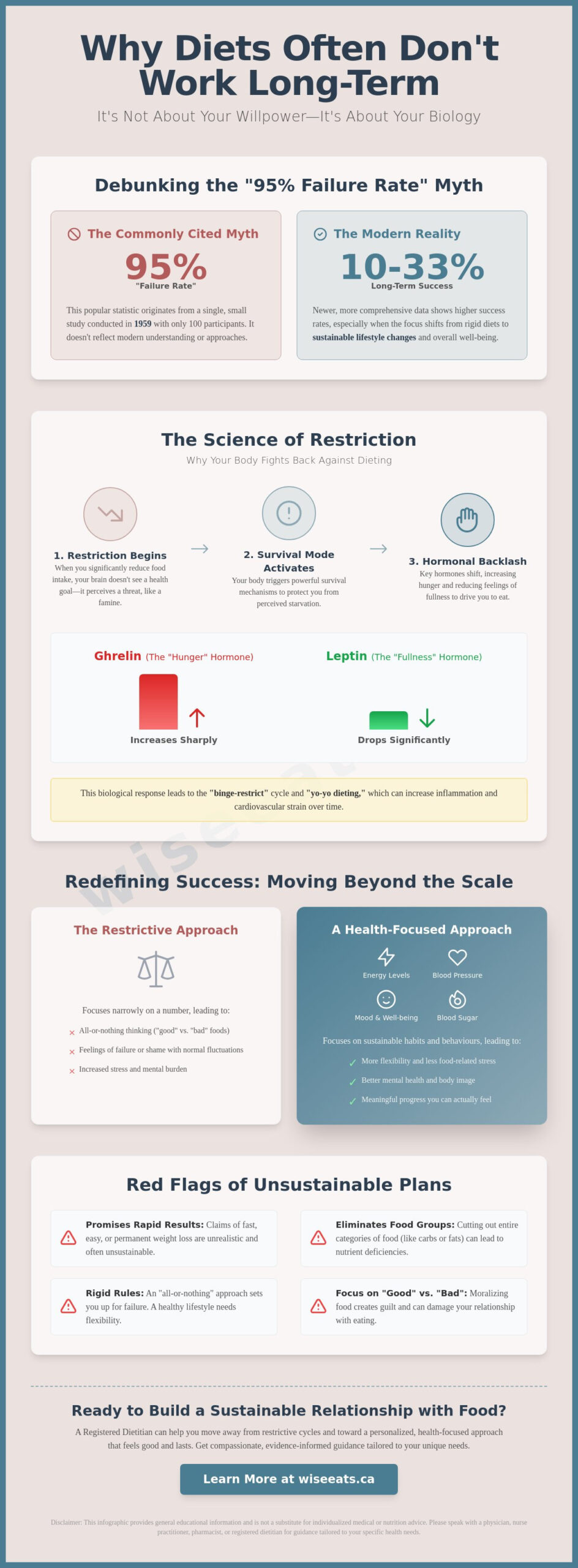
You’ve likely heard the discouraging claim that 95% of people who lose weight will gain it all back within five years. This number has been repeated so often that it’s accepted as an absolute truth. However, this figure actually stems from a single, very small study conducted in 1959. The history of dieting is full of these outdated statistics that don’t reflect the full complexity of human health. Using a sample of only 100 people, the 1959 study found that most participants struggled to maintain their results, but it didn’t account for the lack of support or the extreme restriction involved.
Modern research paints a much more nuanced and hopeful picture. While it’s true that many people experience weight regain, newer data suggests that success rates for long-term health improvements are actually higher, often ranging between 10% and 33%. These figures usually improve when the focus shifts from short-term “fixes” to sustainable, lifestyle-based changes. Understanding why diets fail long term often begins with realizing that the “failure” isn’t yours; it belongs to the restrictive systems that ignore your body’s basic needs.
To better understand the biological side of this journey, watch this helpful video:
When a system requires perfection, it’s designed to break. This breakdown often leads to weight cycling, or “yo-yo dieting,” where weight is lost and regained repeatedly. It’s a stressful process for the body. Research suggests this cycle can contribute to increased inflammation and cardiovascular strain over time. Instead of blaming your willpower, it’s helpful to see regain as a biological signal that the chosen method was too restrictive for your unique life. This perspective shift is a core reason why diets fail long term; they treat your body like a machine rather than a living, adaptive organism.
Redefining What Success Looks Like
Success shouldn’t be a narrow target on a scale. When we look at clinical markers like blood pressure, cholesterol levels, or daily energy, we see a much clearer picture of overall health. Shifting the focus toward sustainable habits allows for flexibility and growth. This weight-neutral approach often leads to better mental well-being because it removes the shame associated with the scale. You might find that having the energy to play with your kids or feeling more alert at work are far more meaningful indicators of progress. Learning how to measure nutrition success without a scale using clinical, behavioural, and functional markers can give you a much richer and more compassionate picture of how your body is truly thriving.
The Problem with Rigid Definitions
Rigid rules create a trap for your mind. If you view food as “good” or “bad,” a single meal can feel like a total collapse of your efforts. This all-or-nothing mindset is a major hurdle in long-term health. Success looks different for everyone. For some, it’s managing digestive comfort; for others, it’s stable blood sugar. Working with a dietitian can help you define what health means for your unique body and help you move away from a “pass or fail” mentality.
This article is for general educational purposes and is not a substitute for individualized medical or nutrition advice. Please speak with a physician, nurse practitioner, pharmacist, or registered dietitian for guidance tailored to your specific needs.
The Science of Restriction: Why Your Body Fights Back
Have you ever felt like your body is actively working against your best intentions? It probably is. When you significantly reduce your food intake, your body doesn’t see a health goal; it sees a famine. This is a primary reason why diets fail long term. To protect you, your brain coordinates a complex hormonal response. Ghrelin, often called the “hunger hormone,” increases to signal that you need energy. Meanwhile, leptin, the hormone that signals fullness, often drops. This combination leaves you feeling constantly hungry and rarely satisfied. These biological responses are survival mechanisms, not flaws in character.
This hormonal shift often triggers a “binge-restrict” cycle. When the drive to eat becomes overwhelming due to biological deprivation, it can lead to eating large amounts of food in a short period. This isn’t a lack of willpower; it’s your body’s way of ensuring it receives the energy it has been denied. This cycle often results in an intense preoccupation with food, where you find yourself thinking about your next meal or “forbidden” snacks all day long. It’s a heavy mental burden that makes rigid plans nearly impossible to sustain over time. Understanding the full scope of the problems with restrictive dieting and why willpower isn’t the solution can help you see these struggles as biological realities rather than personal shortcomings.
Metabolic Adaptation: Your Body’s Protective Shield
The common advice to “eat less and move more” is a massive oversimplification of how humans actually function. Your body strives for homeostasis, often referred to as a “set point.” When you cut calories drastically, your resting metabolic rate can slow down. This is the energy you burn just to keep your heart beating and lungs breathing. Your body becomes more efficient at using the energy it has, which makes further weight loss difficult and regain much easier. It’s like a thermostat that adjusts the temperature to keep things stable. Understanding this helps explain why diets fail long term for so many people.
The Psychology of “Forbidden” Foods
Restriction isn’t just physical; it’s mental. Labeling certain foods as “bad” or “off-limits” often leads to a heightened preoccupation with them. Have you ever experienced the “Last Supper” effect? This happens when you eat large amounts of a “forbidden” food because you plan to start a new, restrictive plan on Monday. It’s a natural response to perceived scarcity. Transitioning toward food neutrality, where all foods are viewed as emotionally equal, can help lower the intensity of these cravings. If you find yourself stuck in this cycle, reaching out for a supportive conversation can be a helpful first step in finding a more balanced path.
This article is for general educational purposes and is not a substitute for individualized medical or nutrition advice. Please speak with a physician, nurse practitioner, pharmacist, or registered dietitian for guidance tailored to your specific needs.
How to Spot a Fad Diet in the Wild
With a new “miracle” plan appearing on social media every week, it’s easy to feel confused. How can you tell the difference between a helpful suggestion and a plan that’s destined to fail? Learning how to spot a fad diet is like developing a protective filter for your mental and physical health. While these plans promise a quick fix, they often ignore the complex biological reasons why diets fail long term, such as the metabolic changes we discussed earlier. A sustainable approach, on the other hand, prioritizes your long-term well-being over a temporary number on the scale.
There are several red flags to watch for when you encounter a new nutrition trend. If a plan requires you to cut out entire food groups, promises rapid results in a matter of days, or insists you buy expensive supplements to see progress, it’s likely a fad. In contrast, evidence-based medical nutrition therapy (MNT) is a personalized approach used by professionals like Registered Dietitians to manage specific health conditions. It focuses on your unique needs rather than a one-size-fits-all set of rules. You might also see “detoxes” or “cleanses” advertised as a way to reset your system. In reality, your liver and kidneys are already working 24/7 to filter your body. For healthy individuals, these restrictive cleanses are biologically unnecessary and can sometimes even be harmful.
Marketing Hype vs. Evidence-Based Nutrition
Have you noticed how certain plans use words like “secret ingredient,” “miracle cure,” or “ancient discovery”? This “hype” language is a major warning sign. Real nutrition science is rarely flashy or secretive; it’s based on years of peer-reviewed research. A sustainable lifestyle pattern focuses on what you can add to your life rather than what you must take away. For example, our evidence-based view on the alkaline diet shows how common it is for trends to lack strong scientific support despite their popularity.
The Hidden Costs of Unsustainable Plans
The toll of a fad diet goes far beyond your grocery bill. Constantly starting and stopping restrictive plans can lead to a cycle of shame and a sense of personal failure. This mental health burden is significant. Restrictive protocols can also lead to nutrient deficiencies, leaving you feeling tired or run down. If you’re already managing digestive issues or other health conditions, these rigid plans can make your symptoms more complex. It’s much kinder to your body to seek a path that feels manageable and supported. For example, if you experience acid reflux or heartburn, working with a dietitian for GERD and acid reflux can help you identify your personal triggers rather than following an overly restrictive one-size-fits-all food list.
This article is for general educational purposes and is not a substitute for individualized medical or nutrition advice. Please speak with a physician, nurse practitioner, pharmacist, or registered dietitian for guidance tailored to your specific needs.
Building a Sustainable Relationship with Food
Instead of focusing on what you must remove from your plate, try shifting your attention to what you can add. This simple change in perspective is a powerful tool for long-term sustainability. Many traditional plans focus entirely on subtraction, which is a major reason why diets fail long term. When we ignore our cultural connections to food or the simple pleasure of a shared meal, we create a system that feels like a chore rather than a way of life. Adding nutrient-dense options like colourful vegetables, fibre-rich grains, or satisfying proteins allows you to nourish your body without feeling deprived.
This approach is often called “gentle nutrition.” It’s about making food choices that honour both your health and your taste buds. You don’t have to choose between a meal that tastes good and one that makes you feel good; they can be the same thing. By practicing food neutrality, you can enjoy a birthday cupcake or a holiday dinner with family without feeling like you’ve “ruined” your progress. Flexibility is the key that allows for life to happen. Whether you’re travelling, attending a social event, or simply having a busy week, a flexible mindset prevents the “all-or-nothing” thinking that often leads to giving up entirely. If you’ve felt trapped in a cycle of yo-yo dieting and want care that focuses on your overall wellbeing rather than the number on the scale, learning about weight-inclusive care from a HAES dietitian in Canada may offer a refreshing and supportive alternative.
The Power of Food Flexibility
A “perfect” diet doesn’t exist, and searching for one often leads to unnecessary stress. Consistency is far more valuable than perfection. When you allow yourself to integrate favourite foods into a balanced pattern, the urge to binge on them often fades. This balance makes it much easier to stay on track over the months and years. We encourage you to discover nutritious Canadian-made foods to add local variety and flavour to your routine. Embracing variety helps keep your meals interesting and satisfying.
Measuring Progress Beyond the Scale
The scale is a limited tool that only tells one small part of your story. There are many other ways to track how your body is responding to better nourishment. Consider this checklist of non-scale victories:
- Waking up feeling more refreshed and having better sleep quality.
- Noticing your digestion feels more settled and comfortable after meals.
- Having stable energy levels that last through the afternoon slump.
- Feeling a sense of peace and less anxiety around food choices.
You can also focus on clinical markers like improved blood sugar levels (A1c) or cholesterol profiles. For a structured, evidence-informed framework covering all of these indicators, explore this comprehensive guide on how to measure nutrition success without a scale. For those who want a more detailed look at their physical changes, tools like body composition analysis can provide a clearer picture of your health than weight alone. If you’re ready to build a plan that fits your actual life and honours your unique needs, contact us to get started.
This article is for general educational purposes and is not a substitute for individualized medical or nutrition advice. Please speak with a physician, nurse practitioner, pharmacist, or registered dietitian for guidance tailored to your specific needs.
When to Seek Professional Guidance
Finding your way through a sea of nutrition advice can feel like trying to navigate a storm without a compass. It’s exhausting to constantly wonder if you’re making the right choice for your body. If you’re feeling overwhelmed by the biological and psychological reasons why diets fail long term, it may be time to seek a knowledgeable partner. In Canada, it’s helpful to know the difference between a Registered Dietitian (RD) and an unregulated “nutritionist.” An RD is a regulated health professional with specific university training and clinical experience. This means they’re held to high ethical and professional standards, providing you with a layer of protection and expertise that unregulated titles may not offer.
Medical nutrition therapy (MNT) is a personalized approach that goes far beyond a simple meal plan. It involves a deep look at your medical history, lifestyle, and unique health goals. Whether you’re managing a specific condition or simply want to improve your relationship with food, MNT provides a supportive framework based on science rather than trends. For those who want care that prioritizes their overall wellbeing without the pressure of the scale, working with a HAES dietitian in Canada offers a compassionate, weight-inclusive approach to managing health conditions and improving quality of life. If you have general questions about how food impacts your well-being, you can ask a dietitian for evidence-informed clarity.
The Role of a Registered Dietitian
Registered Dietitians act as a filter against the noise of the wellness industry. They translate complex nutritional science into practical, everyday steps that fit your life. Instead of giving you a rigid set of rules, an RD works with you to find a rhythm that feels manageable. At Wise Eats Registered Dietitians, we offer custom meal planning and nutrition analysis to help you understand your unique needs without the pressure of a “pass or fail” diet. This partnership focuses on sustainable patterns rather than the restrictive cycles that often explain why diets fail long term.
When to Seek Specialized Support
There are certain situations where specialized support is essential for your safety and well-being. If you find yourself struggling with obsessive thoughts about food, experiencing rapid weight changes, or dealing with persistent digestive distress, these are signals from your body that deserve professional attention. Working with an intuitive eating dietitian in Canada can help you address these patterns with a non-restrictive, evidence-informed approach that supports both your physical and mental well-being. For those managing chronic illnesses, exploring nutrition counselling for medical conditions can provide the steady hand you need during a time of change. You don’t have to navigate your health journey alone.
When to seek help
If you or someone you know is experiencing signs of an eating disorder, severe nutrient deficiencies, or complex medical issues like kidney disease or food allergies, please reach out for an individualized assessment. These topics require a high level of specialized care and cannot be managed through general information alone. Your primary healthcare provider or a Registered Dietitian can help coordinate the right team for your needs.
This article is for general educational purposes and is not a substitute for individualized medical or nutrition advice. Please speak with a physician, nurse practitioner, pharmacist, or registered dietitian for guidance tailored to your specific needs.
Embracing a Sustainable Path Forward
You now have a clearer understanding of how your body’s natural survival mechanisms, like the metabolic shifts and hormonal signals we explored, play a central role in why diets fail long term. By moving away from the rigid frameworks of fad trends and toward the additive, flexible mindset discussed earlier, you can create a lifestyle that feels supportive rather than punishing. This journey isn’t about achieving a perfect standard; it’s about finding consistent, manageable habits that respect your unique biology and cultural connection to food.
Our team at Wise Eats Registered Dietitians is here to help you translate this evidence-based, weight-neutral perspective into a plan that actually works for your daily life. We provide compassionate care tailored specifically to your needs, acting as your guide through the noise of conflicting nutrition advice. Ready to move away from restrictive dieting? Book a consultation with Wise Eats Registered Dietitians today. You deserve a path forward that feels kind, manageable, and sustainable.
This article is for general educational purposes and is not a substitute for individualized medical or nutrition advice. Please speak with a physician, nurse practitioner, pharmacist, or registered dietitian for guidance tailored to your specific needs.
Frequently Asked Questions
Is it possible to lose weight without a restrictive diet?
Yes, it’s possible to see changes in your health and body composition by focusing on sustainable, additive habits rather than restriction. Instead of cutting out entire food groups, you might focus on increasing your intake of vegetables, fibre, and lean proteins. This approach helps maintain your energy levels and supports a healthier metabolism. It’s often the lack of extreme rules that explains why rigid plans are often why diets fail long term.
How long does it typically take to see results from lifestyle changes?
You may notice improvements in your energy levels, sleep quality, and digestion within just a few weeks of making consistent changes. While weight changes often take longer, usually appearing over several months, these “non-scale victories” are excellent indicators that your body is responding well. Patience is key because sustainable shifts happen gradually. Your body needs time to adjust to new patterns without feeling threatened by sudden, drastic changes.
What is the “set point” theory and how does it affect me?
The set point theory suggests that your body has a preferred weight range it tries to maintain to keep you safe and functioning. When you lose weight rapidly, your body may respond by increasing hunger hormones and slowing your metabolism to return to that range. This is a biological survival mechanism. While this range can sometimes shift over a long period with consistent, gentle habits, it explains why your body often resists sudden, extreme restriction.
Can a Registered Dietitian help if I have a history of chronic dieting?
Absolutely. A Registered Dietitian provides a compassionate, non-judgmental space to help you move away from the cycle of chronic dieting for good. We work with you to rebuild trust with your body and develop a flexible eating pattern that honours your health and your taste buds. This partnership is about more than just food; it’s about finding a sustainable way of living that feels manageable and reduces the mental stress of “always being on a diet.”
Why do I feel so hungry when I start a new diet plan?
Intense hunger is often your body’s way of telling you that your new plan is too restrictive for your unique needs. When you don’t eat enough, your brain increases production of ghrelin, the hunger hormone, and decreases leptin, which signals fullness. This is a primary reason why diets fail long term. Your body is simply trying to protect you from what it perceives as a famine. It isn’t a lack of willpower; it’s a powerful biological response.
How can I stop the binge-restrict cycle for good?
Breaking the cycle usually begins by giving yourself permission to eat all foods without guilt or moral labels. When you stop the restriction, the biological drive to binge often loses its intensity. Focusing on “adding” nourishment rather than “subtracting” foods helps stabilize your blood sugar and hunger hormones. It’s a process that takes time and often benefits from professional support. Learning to listen to your body’s internal cues is a vital step toward a peaceful relationship with food.
This article is for general educational purposes and is not a substitute for individualized medical or nutrition advice. Please speak with a physician, nurse practitioner, pharmacist, or registered dietitian for guidance tailored to your specific needs.

Article by
Rachel McBryan, Dietitian
Rachel McBryan is a licenced Dietitian in British Columbia offering comprehensive nutrition counselling as virtual and/or in-person counselling sessions to suit your needs and preferences. With a Bachelor of Science in Nutrition and Food Science, Rachel has over 20 years experience helping people address their health through nutrition. She was awarded Human Nutrition and Food Science BSc.from University of Alberta followed by post-grad course work at UBC in guidance counselling.