
What if the reason you can’t stick to a restrictive diet has nothing to do with your willpower and everything to do with how your body is wired to survive? You might feel like you’re failing every time you reach for a “forbidden” snack, but the truth is often much more complex. Working with an intuitive eating dietitian in Canada can help you see that these moments aren’t a lack of discipline; they’re a natural response to deprivation. It’s exhausting to spend your day categorizing foods as “good” or “bad” while dealing with the constant fog of fatigue and metabolic frustration.
We understand how overwhelming it feels to be stuck in a cycle of restriction and loss of control. In this article, we’ll explore the biological and psychological impacts of dieting to help you understand why your body reacts the way it does. You’ll learn how a non-restrictive, evidence-informed approach can help reduce food anxiety and offer a sustainable path toward health. At Wise Eats Registered Dietitians, we look at the science behind hunger signals and how our professional guidance can act as a steady hand while you navigate these changes.
This article is for general educational purposes and is not a substitute for individualized medical or nutrition advice. Please speak with a physician, nurse practitioner, pharmacist, or registered dietitian for guidance tailored to your specific needs.
Key Takeaways
- Learn why your body naturally adjusts its metabolism and hunger hormones during periods of restriction to keep you safe.
- Understand the science behind the binge-restrict cycle and how it’s often a biological response rather than a lack of discipline.
- Discover how gentle nutrition and consistent eating patterns can help you stabilize your energy and feel more in control.
- Explore the benefits of partnering with an intuitive eating dietitian Canada to build a sustainable, weight-inclusive approach to health.
- Recognize the difference between dietary changes for medical needs and elective restrictions that may be impacting your well-being.
Defining Restrictive Dieting: When “Eating Healthy” Becomes a Burden
Restrictive dieting is often defined as the intentional limitation of energy intake or the exclusion of specific food groups to achieve a specific body size or health outcome. While some people must avoid certain foods for medical reasons, such as a life-threatening allergy or celiac disease, elective restriction is different. It often starts with a genuine desire to feel better, but it can quickly become a heavy mental burden. You might find yourself constantly negotiating with your hunger or feeling guilty for eating something that wasn’t on your “approved” list. This isn’t a lack of discipline; it’s the natural result of a system that prioritizes rules over your body’s actual needs.
In Canada, we see many “wellness” trends that are just dieting in disguise. Terms like “clean eating” or “detoxing” may sound positive, but they often encourage a rigid mindset that labels foods as either good or bad. This can make you feel like you’re constantly walking a tightrope. An Intuitive Eating approach offers a different path, focusing on your body’s internal cues rather than external rules. Validating your desire to be healthy is important, but it’s also helpful to recognize when the methods you’re using are actually making you feel worse. If you have questions about how these patterns affect you, you can always ask a dietitian for more general information.
To better understand this concept, watch this helpful video:
The Spectrum of Restrictive Behaviours
Restriction isn’t always about skipping meals entirely. It can look like cutting out all carbohydrates, avoiding fats, or obsessively using tracking apps to log every bite. This constant monitoring creates a massive mental load that follows you throughout the day. Have you ever turned down a dinner invitation because you weren’t sure if the menu “fit your plan”? This social isolation and the stress of shared meals can take a real toll on your quality of life. When food choices are driven by fear or rigid rules, eating stops being a source of nourishment and starts being a source of anxiety.
Why We Are Drawn to Restriction
It’s easy to see why these plans are popular. Canadian media is full of quick-fix promises that suggest health is just one 30-day challenge away. Many people experience a “honeymoon phase” when they start a new plan. They feel a surge of control and energy, which makes the restriction seem like it’s working. However, this feeling is usually temporary as the body begins to fight back against the lack of energy. Working with an intuitive eating dietitian Canada can help you move past these cycles and find a way of eating that actually fits your lifestyle without the constant pressure of societal body standards.
This article is for general educational purposes and is not a substitute for individualized medical or nutrition advice. Please speak with a physician, nurse practitioner, pharmacist, or registered dietitian for guidance tailored to your specific needs.
The Biological Toll: How Restriction Impacts Your Metabolism
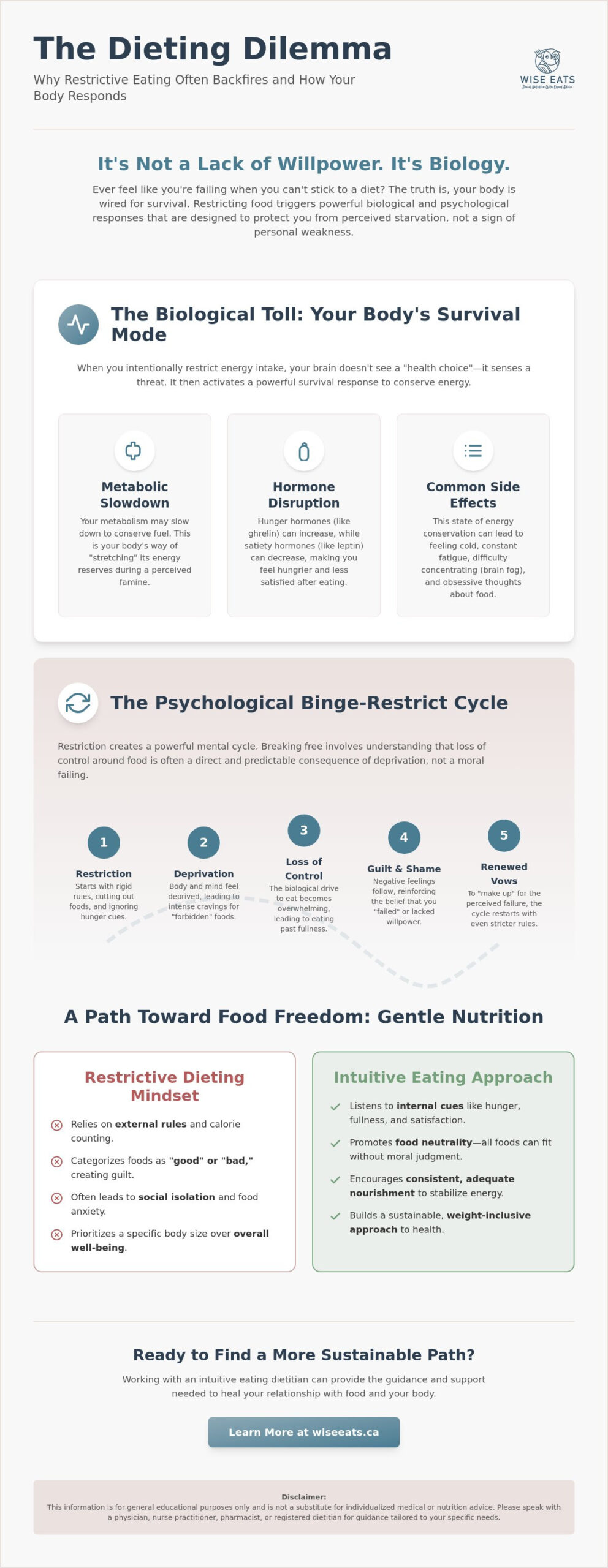
Have you ever wondered why your energy levels dip so low when you’re dieting? It’s not a lack of character. Your body is actually incredibly smart. When you restrict your food intake, your brain doesn’t see a “lifestyle change.” Instead, it perceives a period of scarcity, much like a survival situation. To protect you, it begins to conserve energy by slowing down various biological processes. This protective mechanism is why you might feel colder, more tired, or struggle with brain fog when you’re not eating enough. Your body is simply trying to keep the lights on with fewer resources.
Metabolic Adaptation and the Survival Response
Metabolic adaptation is the body’s natural survival response to perceived scarcity. When you consistently eat less than your body requires, your basal metabolic rate may drop to compensate. This is one reason why weight often returns after a restrictive period ends; your body is seeking stability and trying to rebuild its energy stores. Research into the Metabolic Consequences of Weight Reduction shows that these changes can be persistent. Furthermore, prolonged caloric deficits can lead the body to break down muscle mass for fuel, which further impacts your metabolic health. Understanding these shifts is a key part of the work done by an intuitive eating dietitian Canada, as it helps reframe your physical symptoms as survival signals rather than failures.
Hormonal Shifts and Hunger Cues
Chronic restriction also creates a significant shift in your hormonal balance. Two key players here are ghrelin, which signals hunger, and leptin, which signals fullness. During a diet, ghrelin levels often rise while leptin levels fall. This creates a biological environment where you feel hungrier more often and find it harder to feel satisfied after a meal. Have you ever felt completely preoccupied with thoughts of food? That isn’t a “food addiction.” It’s a biological signal designed to drive you toward nutrition. Additionally, the stress of restriction can increase cortisol levels, which may disrupt your sleep quality and cognitive function.
If you’re tired of fighting your own biology and want to learn how to work with your body instead of against it, you can reach out to us to discuss a more sustainable way forward. An intuitive eating dietitian Canada can help you navigate these hormonal shifts and support you in rediscovering your natural hunger and fullness cues.
This article is for general educational purposes and is not a substitute for individualized medical or nutrition advice. Please speak with a physician, nurse practitioner, pharmacist, or registered dietitian for guidance tailored to your specific needs.
The Psychological Binge-Restrict Cycle: Why Your Brain Fights Back
Restriction creates a psychological pressure cooker. While the biological shifts we discussed earlier prepare your body for survival, your mind begins to focus entirely on what it’s being denied. This isn’t a sign that you lack discipline. It’s actually a sign that your brain is working exactly as it should to protect you from perceived starvation. When you intentionally limit your intake, you enter a predictable loop: restriction leads to a sense of deprivation, which triggers intense cravings. Eventually, these cravings become so powerful that they lead to a binge, followed by a heavy wave of guilt and shame. This cycle is one of the main reasons Why Diets Fail Long Term.
Many people find themselves trapped in the “Last Supper” effect. This happens when you decide that a new diet starts on Monday, so you feel a desperate need to eat all your “forbidden” foods on Sunday night. You might eat until you’re uncomfortably full because you believe you won’t have access to those foods again for a long time. This mindset only strengthens the cycle of overeating and restriction. An intuitive eating dietitian Canada can help you recognize these patterns and offer a way to break free from the constant mental tug-of-war.
The Scarcity Mindset and Food Preoccupation
When certain foods are off-limits, your brain’s reward system becomes hypersensitive to them. Suddenly, a simple cookie becomes the most exciting thing in the room. This hypersensitivity leads to food preoccupation, where you spend a large portion of your day thinking about what you can or cannot eat. You might find that you no longer find pleasure in eating because you’re too focused on following the rules. It’s vital to remember that binging is often a physiological reaction to under-eating. Your brain is simply trying to secure enough energy to keep you safe. It isn’t a lack of willpower; it’s a survival response to a scarcity mindset.
The Emotional Burden of Moralizing Food
Labelling foods as “good” or “bad” creates an unnecessary emotional burden. When you eat a “bad” food, you often feel like a “bad” person. This moralizing leads to a cycle of shame that can deeply impact your self-esteem and mental health. Chronic dieting is often linked to increased irritability and food-related anxiety, making it hard to enjoy social gatherings or simple family meals. Shifting toward a neutral view of all foods can help reduce their psychological power over you. When no food is forbidden, it loses its ability to cause intense cravings and guilt. Working with an intuitive eating dietitian Canada can provide the support needed to navigate these complex emotions and find a more peaceful relationship with food.
This article is for general educational purposes and is not a substitute for individualized medical or nutrition advice. Please speak with a physician, nurse practitioner, pharmacist, or registered dietitian for guidance tailored to your specific needs.
Practical Steps Toward Sustainable Nutrition and Food Freedom
How do we move from the exhaustion of restriction toward a place of peace? The answer often lies in Gentle Nutrition. This is a weight-neutral approach to health that focuses on how food makes you feel rather than what it does to the scale. It’s about building a flexible relationship with food where your choices are driven by self-care, not self-control. You can find more ways to track your progress in our How to Measure Nutrition Success Without a Scale checklist.
One of the most effective ways to stabilize your energy is to prioritize regular, adequate eating patterns. When you eat consistently throughout the day, you help balance the hunger hormones we discussed earlier. This reduces the urge to binge because your body knows that energy is coming. Giving yourself unconditional permission to eat is also vital. When all foods are allowed, they lose their power to trigger the “Last Supper” effect. An intuitive eating dietitian Canada can help you navigate this transition, ensuring you feel supported every step of the way.
Reconnecting with Internal Hunger and Fullness Cues
Your body has its own internal compass. After years of following external diet rules, it’s normal if those signals feel a bit muted. Reconnecting with physical hunger and recognizing when you’re comfortably full takes time and a lot of patience. You might find it helpful to use a hunger scale to check in with yourself before and after meals. Treat this as a mindful tool to gather information, not as a rigid rule to be followed perfectly. Remember, there is no “right” way to feel hunger; it’s about learning what your unique signals look like.
Focusing on Addition Rather Than Subtraction
Instead of thinking about what you need to cut out, try asking what you can add. Could you add more fibre to your breakfast? Maybe some extra protein or a pop of colour with a fresh vegetable? This shift in focus makes eating feel abundant rather than restrictive. Adding variety also supports your gut health and ensures you’re getting a wide range of nutrients. Exploring nutritious Canadian-made foods is a great way to bring more satisfaction to your plate while supporting local producers.
If you’re ready to stop the cycle of restriction and start building a sustainable path to health, connect with us today to learn more about how we can support your journey toward food freedom.
This article is for general educational purposes and is not a substitute for individualized medical or nutrition advice. Please speak with a physician, nurse practitioner, pharmacist, or registered dietitian for guidance tailored to your specific needs.
Finding Support: Working with an Intuitive Eating Dietitian in Canada
In Canada, the title “Dietitian” is a protected term. This means that when you work with a Registered Dietitian, you are consulting a regulated health professional who has met rigorous educational and clinical standards across the country. This national regulation ensures that the information you receive is ethical and evidence-informed. While many people use the term “nutritionist,” it doesn’t carry the same regulatory weight in every province. An intuitive eating dietitian Canada acts as a knowledgeable partner, helping you translate complex biological signals into a practical, flexible way of eating that fits your life.
Choosing to step away from restrictive dieting is a brave decision. Personalized nutrition counselling provides a safe space to explore your history with food without the fear of judgment or the pressure of another “plan.” We focus on rebuilding the trust between your mind and your body that chronic dieting often breaks down. If you’re ready to explore a different path, you can find professional guidance through our contact page.
Signs You May Benefit from Professional Nutrition Counselling
You don’t need a diagnosed eating disorder to deserve support. Many adults struggle with “lifestyle” restriction that still causes significant stress and physical symptoms. You might benefit from a consultation if you experience:
- Obsessive thoughts about food, calories, or tracking apps that interfere with your daily life.
- A loss of your menstrual cycle, which can sometimes be a sign of inadequate energy intake.
- Feelings of intense guilt or a sense of being “out of control” around certain foods.
- Persistent fatigue or metabolic frustration despite “doing everything right.”
When to Seek Help
While general education is helpful, certain situations require an individualized medical assessment. Please seek support from a specialized healthcare team if you are experiencing symptoms of a clinical eating disorder, managing a complex medical condition like kidney disease, or dealing with severe food allergies. A Registered Dietitian can work alongside your physician or nurse practitioner to ensure your nutritional plan is safe and appropriate for your specific medical needs.
In addition to nutritional guidance, addressing co-occurring mental health concerns is often a vital step; for those seeking specialized support, Hope Therapy Center provides psychiatry and medication management services that can assist in managing the psychological aspects of recovery.
The Wise Eats Approach to Weight-Inclusive Care
At Wise Eats, we utilize a weight-inclusive, HAES-informed approach. This means we focus on health behaviours and internal cues rather than the number on a scale. We help you move away from rigid rules and toward food freedom by using evidence-based strategies that respect your individual goals. Whether you are navigating digestive health nutrition with the right professional support, such as understanding the differences between a dietitian vs naturopath for IBS, or seeking eating disorder recovery, our goal is to provide a steady hand during times of change. You can begin this process by booking a consultation to discuss your needs in a supportive environment.
This article is for general educational purposes and is not a substitute for individualized medical or nutrition advice. Please speak with a physician, nurse practitioner, pharmacist, or registered dietitian for guidance tailored to your specific needs.
Embracing a Sustainable Path to Food Freedom
Moving away from the cycle of restriction isn’t about finding more willpower; it’s about understanding the biological and psychological protective mechanisms that have been at play. By recognizing how metabolic adaptation and the binge-restrict cycle impact your well-being, you can begin to prioritize self-care over rigid control. Working with an intuitive eating dietitian Canada offers a way to navigate these shifts with evidence-based, weight-neutral nutrition care. Whether you’re seeking compassionate support for eating disorder recovery or simply want to feel more at peace in your body, our team provides a supportive environment. You don’t have to do this alone.
Book a consultation with a Wise Eats Registered Dietitian to find your path to food freedom. Our licensed Registered Dietitians across Canada are ready to help you rediscover a nourishing, flexible relationship with food. You deserve to feel at peace with your body and your plate.
This article is for general educational purposes and is not a substitute for individualized medical or nutrition advice. Please speak with a physician, nurse practitioner, pharmacist, or registered dietitian for guidance tailored to your specific needs.
Frequently Asked Questions
What are the main problems with restrictive dieting?
Restrictive dieting often leads to biological stress, social isolation, and an intense preoccupation with food that can impair your mental health. These plans frequently fail long-term because they ignore your body’s natural hunger signals and metabolic needs. Instead of improving your health, they can create a cycle of weight cycling and increased anxiety. This constant mental load can make eating feel like a source of stress rather than nourishment.
Can restrictive dieting permanently impact my metabolism?
Restrictive dieting triggers metabolic adaptation, which is your body’s way of conserving energy during a perceived scarcity. While these changes are significant, they aren’t necessarily permanent, though they can be persistent. Your body naturally seeks stability. Providing consistent and adequate nourishment is the primary way to support your metabolic rate and help your body feel safe again after a long period of restriction.
How do I know if my “healthy eating” has become too restrictive?
Your eating habits may have become too restrictive if they start to feel like a mental burden or interfere with your social life. Common signs include obsessive food tracking, feeling intense guilt after eating “forbidden” foods, or experiencing constant fatigue. If your food rules are causing more stress than wellness, it’s a good time to re-evaluate your approach and focus on flexibility instead of rigid control.
Why do I feel so hungry all the time when I try to diet?
You feel hungry because your body is producing more ghrelin, the hunger hormone, in response to an energy deficit. This is a biological survival mechanism designed to drive you toward food. It isn’t a failure of willpower or a lack of discipline. It’s your brain’s way of ensuring you get the nutrients and energy you need to function and stay safe.
Is it possible to improve my health without using a restrictive diet?
Yes, you can improve your health by focusing on health-promoting behaviours rather than just weight or restriction. This includes adding variety to your meals, prioritizing sleep, and finding joyful ways to move. Working with an intuitive eating dietitian Canada can help you shift your focus toward these sustainable, weight-neutral habits. This approach allows for health improvements that don’t rely on the stress of deprivation.
How long does it take for the body to recover from chronic dieting?
The timeline for recovery from chronic dieting varies for everyone and depends on your history and current nutritional status. It can take several months or even years to fully restore your physical health and rebuild a peaceful relationship with food. Patience is essential during this process. Your body needs time to learn that food will be consistently available before it can settle into a new rhythm.
What is the binge-restrict cycle and how can I break it?
The binge-restrict cycle begins with restriction, which leads to deprivation and eventually a binge as a biological survival response. Breaking this cycle requires giving yourself unconditional permission to eat all foods and ensuring you eat enough throughout the day. When no food is labelled as “off-limits,” the intense drive to overeat often begins to fade. Consistency and adequacy are the keys to finding balance again.
How can a Canadian Registered Dietitian help with food freedom?
A Canadian Registered Dietitian provides evidence-informed guidance to help you navigate the transition away from rigid dieting rules. They offer professional support in reconnecting with your hunger cues and implementing gentle nutrition that respects your unique needs. An intuitive eating dietitian Canada acts as a steady partner, helping you translate complex body signals into a practical and flexible way of eating that supports your long-term well-being. If you’re also managing gut health concerns, learning about the differences between a dietitian vs naturopath for IBS can help you choose the right professional support for your needs.
This article is for general educational purposes and is not a substitute for individualized medical or nutrition advice. Please speak with a physician, nurse practitioner, pharmacist, or registered dietitian for guidance tailored to your specific needs.
Article by
Rachel McBryan, Dietitian
Rachel McBryan is a licenced Dietitian in British Columbia offering comprehensive nutrition counselling as virtual and/or in-person counselling sessions to suit your needs and preferences. With a Bachelor of Science in Nutrition and Food Science, Rachel has over 20 years experience helping people address their health through nutrition. She was awarded Human Nutrition and Food Science BSc.from University of Alberta followed by post-grad course work at UBC in guidance counselling.
An eating disorder is a serious mental health illness.
If you are in immediate distress or crisis, please contact emergency services by dialing 911 or calling Vancouver Island Crisis Line: 1-888-494-3888. This article is educational information only, not professional diagnosis or treatment. Content is AI generated and may not be reviewed for accuracy.