
What if the number on your scale was the least interesting thing about your health? For years, many of us have been taught that a smaller body is the only path to wellness, leaving people to wonder: is it possible to be healthy at any size? If you’ve spent years caught in the exhausting cycle of weight loss and gain, or felt the anxiety of being judged in a medical setting because of your proportions, you aren’t alone. It’s completely normal to feel overwhelmed by a culture that treats your body like a project to be finished rather than a person to be cared for.
We want to offer you a different perspective, one rooted in evidence and deep self-compassion. In this guide, you’ll discover the reality of weight-inclusive health and learn how to focus on your well-being without the crushing pressure of the scale. We will explore how you can improve clinical markers like blood sugar and energy levels while finding genuine peace with food. It’s time to move toward a version of health that helps you realize your potential for vitality, in a way that feels sustainable and uniquely yours.
Key Takeaways
- Learn why weight is simply a measure of your body’s relationship with gravity rather than a definitive diagnostic tool for your overall health.
- Explore the evidence-based HAES® framework to understand how is it possible to be healthy at any size by pursuing well-being at your current weight.
- Discover how to prioritize health-promoting behaviours you can control, such as consistent nourishment, instead of focusing on restrictive dieting.
- Understand why weight-neutral approaches may lead to better long-term improvements in clinical markers like blood sugar and energy levels.
- Learn how a weight-inclusive dietitian can support you through personalized meal planning that honours your unique lifestyle and food preferences.
Debunking the Myth: Why Weight Isn’t a Reliable Measure of Health
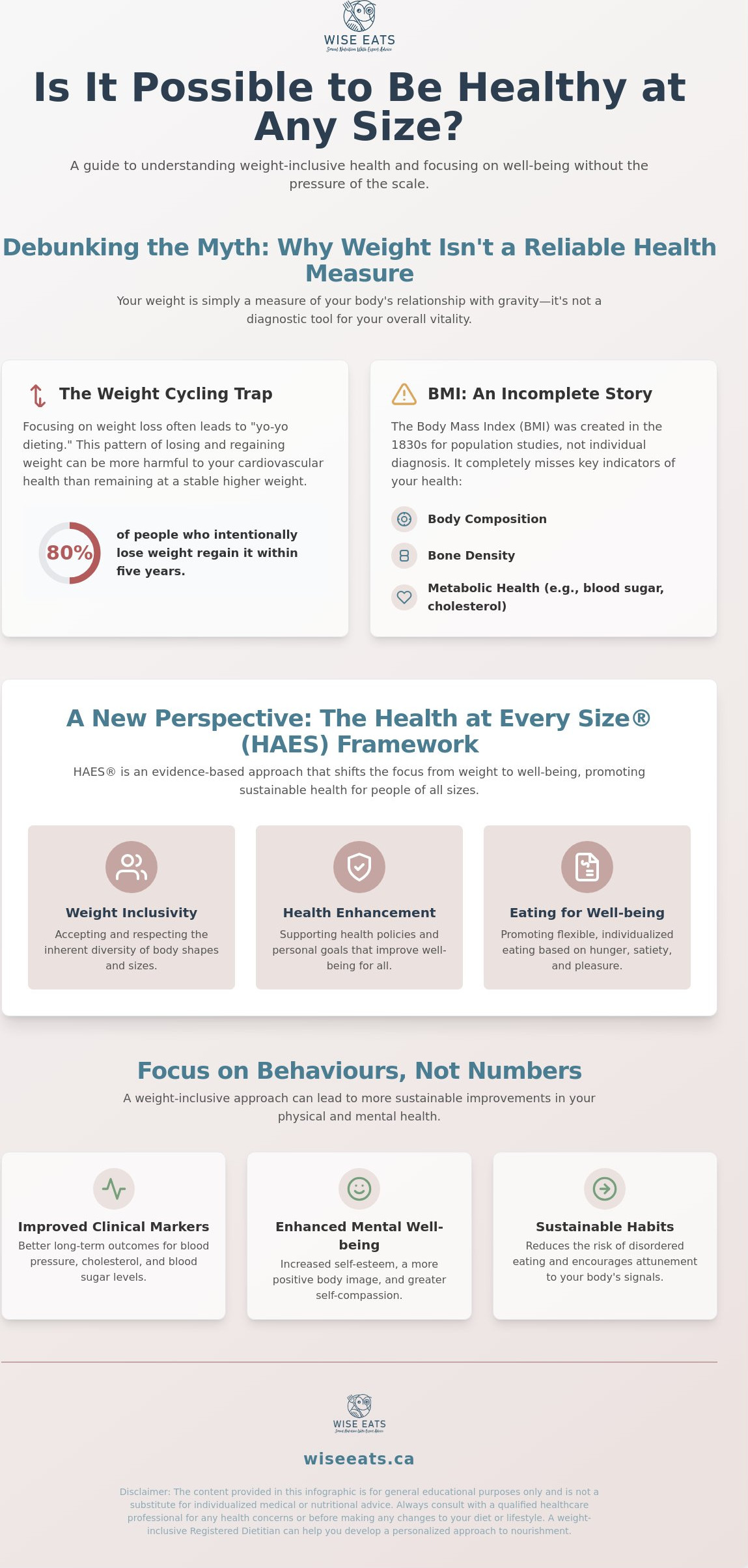
We often treat the number on the scale like a grade on a report card. However, weight is simply a description of your body’s relationship with gravity; it is not a diagnostic tool that tells the whole story of your vitality. If you have been asking yourself, is it possible to be healthy at any size, the answer begins with separating your worth from a measurement. Weight-inclusive care is a model that prioritizes well-being and health behaviours over body size. This approach recognizes that health exists on a continuum for everyone, regardless of their size, and focuses on what your body can do rather than how much space it occupies.
Focusing solely on weight often leads to a cycle of weight cycling, commonly known as yo-yo dieting. This pattern of losing and regaining weight can be physically and mentally exhausting. Research shows that only about 1 in 5 Canadians maintain weight loss for more than a year, with 80% regaining that weight within five years. This constant fluctuation may actually be more harmful to your cardiovascular health and metabolism than remaining at a stable, higher weight. By shifting away from the scale, you can begin to focus on sustainable habits that actually improve your quality of life.
The Limitations of the BMI Scale
The BMI scale was never intended to be a clinical health marker for individuals. It was created in the 1830s as a tool to study populations, not to diagnose the health of a person. BMI misses critical information like muscle mass, bone density, and where your body stores fat. It also ignores metabolic health indicators. Instead of relying on this outdated calculation, we encourage you to unlock a clearer picture of your body composition by looking at biomarkers. Blood pressure, blood sugar levels, and your daily energy provide much more meaningful data about your internal health than a simple ratio of height to weight.
Weight Stigma and Healthcare Access in Canada
Many people in larger bodies experience “medical gaslighting,” where their physical symptoms are ignored in favour of a lecture about weight. This stigma isn’t just frustrating; it’s a barrier to proper care. Weight stigma itself can cause chronic stress, which leads to poor health outcomes independently of a person’s actual weight. Every Canadian has the right to compassionate healthcare that treats the person, not the size. The principles of Health at Every Size advocate for healthcare as a fundamental right, ensuring that person-centered care is offered to everyone without bias or judgment.
What Does Science Say? Understanding the HAES® Framework
The “Health at Every Size” (HAES) framework is often misunderstood as a claim that everyone is automatically healthy regardless of their weight. In reality, it is a compassionate, evidence-based approach that suggests everyone can pursue health at their current size. This paradigm shifts the focus from a number on a scale to the actual behaviours that support your body. When we look at the data, this shift helps answer the question: is it possible to be healthy at any size? The science suggests that focusing on well-being rather than weight loss can lead to more sustainable improvements in your life.
Research indicates that weight-neutral interventions often result in better long-term improvements in physiological markers like blood pressure and cholesterol levels. A scientific review of the HAES paradigm found that people who follow these principles often experience better self-esteem and a more positive body image. This approach also encourages body attunement, which is the practice of listening to your internal signals. By learning to trust your body again, you can make health choices that feel natural rather than forced. In some cases, a weight-inclusive approach may also reduce the risk of developing disordered eating patterns.
The Core Principles of Weight-Inclusive Care
- Weight Inclusivity: This principle involves accepting and respecting the inherent diversity of body shapes and sizes rather than pathologizing certain weights.
- Health Enhancement: This focuses on supporting personal health goals and community-wide policies that improve access to information and services for everyone.
- Eating for Well-being: We promote flexible, individualized eating based on hunger, satiety, and nutritional needs rather than following external diet rules.
Why Diets Fail and What Works Instead
Most restrictive diets fail because they work against your biology. You can learn more about Why Diets Fail Long Term by looking at the Set Point Theory. This theory suggests your body has a biological range it tries to maintain. When you restrict food, your body protects itself by slowing your metabolism and increasing hunger signals. Instead of fighting your body, we focus on nourishing it. If you are ready to explore a more peaceful approach to nutrition, you can book a consultation with our team to start your journey.
Shifting the Focus: Health-Promoting Behaviours You Can Control
Instead of subtracting things from your life, what if you focused on adding? This shift is central to understanding how is it possible to be healthy at any size. It moves the goalposts away from the scale and toward your daily habits. When you focus on behaviours you can actually control, you empower yourself to make lasting changes. Consistent nourishment and adequate hydration are simple yet powerful ways to support your body’s natural functions. These habits keep your energy levels stable and help you feel more present in your daily life.
Sleep and stress management often have a greater impact on your clinical markers than your weight. High stress levels can disrupt your hormones and digestion, regardless of your body size. Practising these behaviours with self-compassion is key. It’s not about being perfect; it’s about finding what works for your unique lifestyle. As highlighted by Johns Hopkins University on Health at Every Size, this framework allows you to prioritize your whole self rather than a single measurement.
Intuitive Eating and Body Trust
Intuitive eating is the process of reconnecting with your internal cues like hunger and fullness. For many, diet culture has silenced these signals, leading to a disconnect between mind and body. By healing your relationship with food, you can let go of rigid “food rules” that cause anxiety. This trust-based approach often leads to more balanced nutrition choices because you are eating to satisfy your body’s genuine needs rather than following a restrictive plan.
Joyful Movement vs. Punitive Exercise
We often view exercise as a way to “burn off” what we ate, but movement should be about pleasure and vitality. Only 45% of Canadian adults currently meet the recommended 150 minutes of weekly activity. We can improve this by finding movement that feels good. This might be a gentle walk through a local BC park or stretching in your living room. All movement counts, and it should leave you feeling energized rather than punished.
Personalized Support: Supplements and Meal Planning
A Registered Dietitian can help you identify nutrient gaps that have nothing to do with your weight. We focus on how your body functions at a cellular level. This may include personalized vitamin support through services like VitaminLab to ensure you have the right building blocks for health. If you are ready to build a nutrition plan that honours your body without the pressure of dieting, you can book your initial assessment with us today.
Working with a Weight-Inclusive Canadian Dietitian
Navigating your health can feel like trying to find your way through a dense fog. A Registered Dietitian acts as a “Knowledgeable Partner” to help you clear the air. You deserve a space where your health goals are heard without the conversation immediately shifting to your weight. We focus on your unique journey, ensuring you feel empowered rather than judged. This partnership allows you to explore the question, is it possible to be healthy at any size, while receiving practical, evidence-based guidance. You don’t have to figure this out alone; we are in this together.
Our approach involves a collaborative process of custom meal planning that respects your personal preferences, budget, and cultural background. We don’t believe in one-size-fits-all templates. Instead, we work together to find a rhythm of eating that feels sustainable and honours your body’s needs. This weight-inclusive care is especially vital for those navigating eating disorder recovery. In these situations, the focus remains on nourishment as a form of healing and restoring a flexible, peaceful relationship with food. It is about building a life where food is no longer a source of constant anxiety.
When to Seek Professional Support
How do you know when it’s time to reach out? Certain red flags can indicate that your relationship with food needs some extra care. These might include:
- Feeling obsessed with food numbers like calories, grams, or points.
- Avoiding social events because you are worried about the food being served.
- Experiencing intense guilt or shame after eating certain foods.
- Feeling like you must “earn” your food through exercise.
You can find more details in our guide on Red Flags to Watch for in Nutrition Advice. Seeking help is a courageous step toward a better quality of life and improved mental health. It is an investment in your future self.
Accessing Care in British Columbia and Alberta
Wise Eats provides virtual consultations for residents across Western Canada, including those in Edmonton, Nanaimo, and throughout Vancouver Island. Working with a licensed professional who understands the Canadian food landscape ensures your advice is realistic and accessible. Our team acts as a filter against misinformation, providing a steady hand as you make changes. We prioritize your peace of mind and clinical markers over the scale. If you are ready to shift your focus toward well-being and explore how is it possible to be healthy at any size, book a discovery call with a Wise Eats dietitian today.
Embrace a Future Focused on Vitality
Choosing to step away from the scale is a powerful act of self-care. By understanding that is it possible to be healthy at any size, you open the door to a world where health is defined by how you feel rather than what you weigh. We have explored how shifting your focus to consistent nourishment, joyful movement, and body trust can lead to lasting improvements in your clinical markers and your overall peace of mind. Your health journey is a practice of self-compassion, not a destination determined by a number.
Our team of Registered Dietitians, licensed in BC and Alberta, is here to act as your expert guide. We specialize in an evidence-based, weight-neutral approach, with specific expertise in eating disorder recovery and digestive health. You don’t have to navigate the noise of diet culture alone; we are ready to help you build a personalized strategy that honours your unique needs and lifestyle. If you are ready to find a more balanced and flexible relationship with food, book a compassionate consultation with a Registered Dietitian today. You deserve to feel empowered and at peace in your body exactly as it is right now.
Disclaimer: This content is for general educational purposes and is not a substitute for individualized medical advice.
Frequently Asked Questions
Is HAES just an excuse to be ‘unhealthy’?
No, HAES is a framework that helps answer the question: is it possible to be healthy at any size? It encourages people to pursue health regardless of their weight. It isn’t about ignoring health; it’s about shifting the focus to behaviours you can control, like eating for well-being and joyful movement. This approach recognizes that everyone has the right to care and that health is a multifactorial concept that isn’t defined by a scale.
Can I still want to lose weight and be HAES-aligned?
It’s completely normal to want to lose weight in a society that often rewards smaller bodies. While HAES focuses on weight neutrality, being HAES-aligned means we acknowledge those desires while choosing to focus our energy on health-promoting behaviours instead of the scale. We work together to help you find peace with food and your body, even while navigating the complicated feelings that come with living in a weight-centric world.
How do I talk to my doctor about weight-inclusive care in Canada?
You can start by being direct with your healthcare provider about your preferences for weight-neutral care. You might say, “I would like to focus on my clinical markers and symptoms today rather than my weight.” You have the right to compassionate care that treats you as an individual. If a doctor suggests weight loss, you can ask, “What treatment would you recommend for a person in a smaller body with these same symptoms?”
What if my blood work shows I have health issues related to my weight?
When asking is it possible to be healthy at any size, it’s helpful to remember that many clinical issues can be managed through consistent nourishment and stress management without focusing on weight loss. We focus on the behaviours that improve those specific markers. We look at what we can add to your lifestyle to support your body’s function and improve your vitality rather than obsessing over a number.
How does a weight-neutral approach help with digestive problems like IBS?
A weight-neutral approach is very effective for digestive health because it removes the stress and restriction often associated with dieting. For those with IBS, restrictive eating can actually worsen symptoms or lead to a disconnect from hunger cues. By focusing on gentle nutrition and identifying specific food triggers without the pressure of a “diet,” you can find relief and improve your overall digestive well-being in a sustainable way.
Is it possible to be healthy at any size if I have a chronic condition like diabetes?
Yes, it’s absolutely possible to pursue health and manage your condition while living in a larger body. Managing diabetes is about consistent nourishment, movement, and monitoring your blood sugar levels rather than hitting a specific weight. By focusing on health-promoting habits, you can improve your energy and manage your condition effectively. This approach helps reduce the shame often associated with chronic illness and empowers you to care for your body.
Article by
Rachel McBryan, Dietitian
Rachel McBryan is a licensed Dietitian in British Columbia offering comprehensive nutrition counselling as virtual and/or in-person counselling sessions to suit your needs and preferences. With a Bachelor of Science in Nutrition and Food Science, Rachel has over 20 years of experience helping people address their health through nutrition. She was awarded a BSc in Human Nutrition and Food Science from the University of Alberta, followed by post-graduate coursework at UBC in guidance counselling.
An eating disorder is a serious mental health illness.
If you are in immediate distress or crisis, please contact emergency services by dialling 911 or calling the Vancouver Island Crisis Line: 1-888-494-3888. A dietitian, psychologist, psychiatrist, and medical team work together to support eating disorder recovery. This article is for educational information only, not professional diagnosis or treatment. Content is AI-generated and may not be reviewed for accuracy.