
What if the reason you feel out of control around certain foods isn’t a lack of willpower, but a disconnection from your own internal compass? It’s a frustrating cycle. You try to follow a plan, yet find yourself overwhelmed by anxiety every time you open the pantry. If you’ve spent years following external rules, it’s completely normal to feel like you’ve lost the map to your own hunger. Learning how to trust your body with food again isn’t about finding a new set of rules to follow. It’s about rebuilding a relationship that has been strained by diet culture and self-doubt.
We know that this process can feel daunting, especially when it’s hard to recognize your hunger and fullness cues. You aren’t alone in this struggle, and your body isn’t broken. This guide provides a compassionate, evidence-based roadmap to help you move from food-related stress to a place of genuine peace. We will explore practical ways to reconnect with your physical sensations and embrace food flexibility. You’ll learn how to move toward a future where nourishment feels simple, supportive, and entirely within your own hands.
Key Takeaways
- Discover why chronic dieting often silences your natural biological signals and how to begin the process of unlearning rigid food rules.
- Learn how consistent nourishment provides the metabolic stability necessary for you to understand how to trust your body with food again.
- Explore practical tools for building interoceptive awareness, allowing you to recognize and respond to your body’s unique hunger and fullness cues.
- Understand that rebuilding body trust is a non-linear journey and find strategies to navigate the normal setbacks and changing sensations along the way.
- See how working with a Registered Dietitian can help you translate body data into a flexible plan that supports your individual needs without restriction.
Understanding Why We Lose Trust in Our Bodies
Body trust is the quiet, steady ability to respond to your internal cues without fear or hesitation. It’s the confidence that you can hear a hunger signal and satisfy it, or feel a fullness cue and stop, without a mental argument. But for many of us, this internal compass feels broken. When you’ve spent years listening to apps, books, or social media influencers tell you when and what to eat, your natural biological signals get buried under a mountain of external rules. Learning how to trust your body with food again begins with recognizing that this disconnection wasn’t your fault.
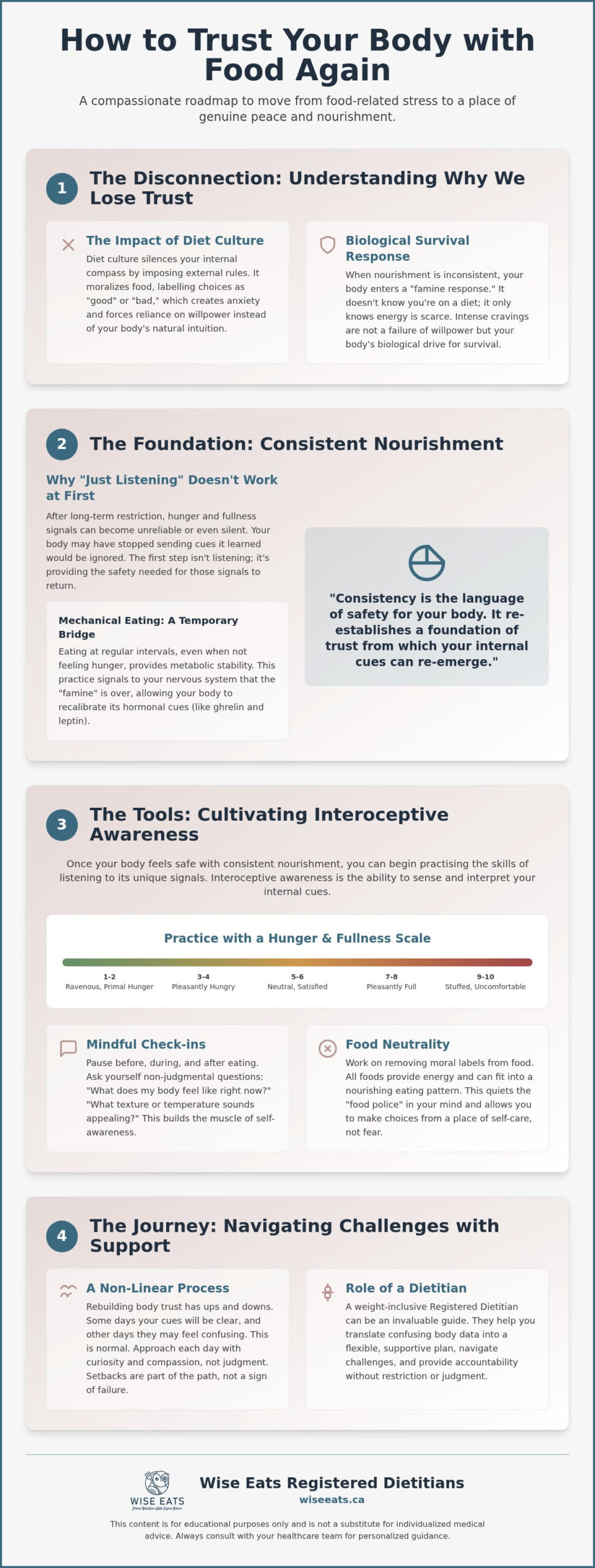
Diet culture plays a significant role in this process by moralizing food and body size. It labels certain choices as “virtuous” and others as “failures,” creating a climate of anxiety around every meal. This constant judgment forces us to rely on willpower rather than intuition. Over time, we stop trusting ourselves because we’ve been taught that our bodies are problems to be solved rather than partners to be nurtured. Validating this struggle is essential; losing trust in your body is often a survival mechanism used to cope with a confusing and restrictive environment, not a personal failure of character.
The Impact of Diet Culture on Intuition
When we rely on external metrics like calorie tracking or rigid macros, we effectively mute our brain’s natural hunger signals. This creates a “rebound effect.” If you’ve ever felt out of control around food after a period of strict rules, that isn’t a lack of willpower; it’s your biology fighting back against deprivation. To lower the anxiety of this process, we often use the principles of intuitive eating to foster food neutrality. This means viewing food as morally neutral fuel and pleasure, which helps quiet the “food police” in your mind. If you’re looking for more ways to shift your mindset, our nutrition advice blog offers many resources on unlearning these harmful narratives.
Biological Survival vs. Personal Trust
Your body is a masterpiece of survival. When nourishment is inconsistent or restricted, your system enters what we call a “famine response.” It doesn’t know you’re trying to follow a new trend; it only knows that energy is scarce. In this state, your brain increases its focus on food to ensure you don’t starve. Your body is biologically programmed to prioritize survival over willpower whenever it perceives a lack of consistent nourishment. Those intense cravings you experience are often just your body’s way of asking for the energy it needs to function. By providing regular, adequate nourishment, you can signal to your nervous system that the “famine” is over, which is the first step in rebuilding a foundation of safety and trust.
The Foundation of Rebuilding: Consistent Nourishment
If you’re wondering how to trust your body with food again, the first step isn’t actually listening to your body. That might sound counterintuitive. However, if your body has been undernourished or subject to inconsistent eating patterns, it’s likely in survival mode. In this state, your internal signals are often muted, loud, or just plain confusing. This is where mechanical eating comes in as a temporary, vital tool to restore metabolic stability. It acts as a bridge, moving you from a state of chaos to a place of predictability and safety.
Consistent energy intake is the only way to regulate hormones like ghrelin, which signals hunger, and leptin, which signals fullness. When nourishment is sporadic, these hormones can become out of balance. This leaves you feeling perpetually hungry or unable to sense when you’ve had enough. By eating at regular intervals, you provide the proof your nervous system needs to feel secure. Consistency is the language of safety for your body. Think of it as a contract; every time you eat on time, you’re signing a promise that you’ll take care of your physical needs. This allows your metabolism to realize that the “famine” is over, which eventually brings those natural cues back online.
Why “Just Listening” Doesn’t Work Early On
After long-term restriction, hunger cues may be silent. Your body has learned that signaling hunger doesn’t result in food, so it stops wasting the energy to ask. Understanding why diets fail long term helps illustrate how metabolic adaptation makes these cues unreliable. This isn’t about ignoring your body forever; it’s about giving it the resources it needs to start talking again. Regular intervals help stabilize your blood sugar and mood. This creates a steady foundation where you can eventually begin to hear what your body is trying to say without the static of survival mode.
Creating a Safe Environment for Food Exploration
Permission to eat is a cornerstone of learning how to trust your body with food again. It involves treating all foods as morally neutral and focusing on satisfaction as much as physical fullness. When you remove the pressure of “getting it right,” you reduce the decision fatigue that often leads to anxiety. Organizing your kitchen to be a supportive space can help lower these triggers. If you feel overwhelmed by these first steps, reaching out for guided support can provide the clarity you need to move forward with confidence and peace of mind.
Practical Tools for Cultivating Interoceptive Awareness
Once you have established a foundation of consistent nourishment, you can begin to shift your focus toward interoceptive awareness. This is simply the ability to perceive physical sensations from within your body, such as a heartbeat, a shiver, or the subtle stretch of your stomach. Think of it as tuning a radio to a station that has been fuzzy for a long time. Learning how to trust your body with food again requires you to become a curious observer of these internal signals without the weight of judgment. This isn’t about following a new set of rigid rules; it’s about building a bridge of communication between your mind and your physical self.
One helpful tool in this process is the Hunger and Fullness Scale. Imagine a scale from one to ten, where one is painfully hungry and ten is uncomfortably full. This scale acts as a neutral guide rather than a strict boundary. It helps you collect data about what your body is feeling in real time. We suggest using a five-step process to check in with yourself:
- Pause and Breathe: Take a moment to settle your nervous system before you begin.
- Scan the Body: Notice any physical sensations from your head to your toes.
- Acknowledge Your Needs: Identify what kind of hunger you are experiencing.
- Taste and Tune In: Pay attention to the flavours and textures as you eat.
- Assess Satisfaction: Notice how your energy and mood shift after nourishment.
The Pre-Meal Check-In
Before you start eating, take a moment to notice where you land on the scale. Are you feeling a growling stomach, a dip in energy, or perhaps that irritable “hangry” sensation? You might also notice “taste hunger,” which is a specific desire for a certain flavour or texture regardless of physical emptiness. All types of hunger are valid and deserve a response. By acknowledging these feelings without judgment, you validate your body’s needs and reinforce the sense of safety we discussed in earlier sections.
Mindful Presence and Satisfaction
Centring yourself before a meal can help lower your stress response, making it easier to hear your body’s cues. Try taking three deep breaths to help your mind arrive at the table. During the meal, consider the “satisfaction factor.” This is the psychological part of eating that helps your brain register that you have had enough. Does the food actually taste good? Is the temperature right? Using a journal to track these patterns can be incredibly revealing. Focus on your feelings and sensations rather than numbers or grams. For more tips on building a peaceful relationship with food, our nutrition advice blog offers many supportive resources to help you stay the course.
Navigating Challenges and Knowing When to Seek Help
Rebuilding a relationship with nourishment is rarely a straight line. You might have weeks where you feel deeply connected to your internal cues, followed by a day where old food rules suddenly feel very loud again. This non-linear path is a normal part of the process. When you start the journey of learning how to trust your body with food again, you are essentially asking your brain to let go of years of protective, albeit restrictive, habits. This shift often triggers a “fear of the unknown.” As your physical sensations change and your energy levels stabilize, it’s natural to feel a bit unmoored.
We also need to acknowledge the fear of weight changes and shifting body image. In a culture that frequently moralizes body size, trusting your body to find its own natural equilibrium can feel incredibly brave and, at times, terrifying. When these fears resurface, try to meet them with radical self-compassion. Remind yourself that your body is not a project to be managed, but a living system that deserves consistent care. If you find yourself slipping back into old patterns of restriction or judgment, see it as data rather than a failure. It’s simply a sign that your system is seeking safety in familiar ways.
When to Seek Professional Help
While the goal is self-trust, there are times when professional guidance is necessary to ensure your safety and well-being. If you experience physical red flags such as fainting, dizziness, or persistent fatigue, it is vital to consult your healthcare team. Emotional red flags are equally important to notice. If thoughts about food become obsessive, or if you feel an intense sense of panic at the thought of eating without a specific rule, you don’t have to navigate this alone. A Registered Dietitian for eating disorder recovery can provide a structured safety net. We can help you challenge fear foods in a way that feels manageable and supported.
Handling Digestive Discomfort in Recovery
It is very common to experience bloating or slow digestion as you begin to eat more consistently. After a period of restriction or irregular patterns, your gut effectively needs to “re-learn” how to process food efficiently. This discomfort is usually temporary and often responds well to gentle movement and staying adequately hydrated. If these symptoms feel overwhelming or persist, seeking specialized nutrition for digestion problems can help you find relief while staying committed to your recovery. If you are ready for a personalized approach to these challenges, you can book a supportive consultation with our team to start your journey toward food flexibility.
The Role of a Registered Dietitian in Your Journey
A Registered Dietitian acts as an expert guide, helping you translate complex body data into a sustainable, compassionate plan. When you are learning how to trust your body with food again, having a professional to filter out misinformation is invaluable. We take a weight-inclusive approach, focusing on Health at Every Size (HAES) principles. This means our priority is your well-being and your relationship with food, rather than a number on a scale. We also look at the biological side of trust. For instance, nutrient deficiencies can often mimic anxiety or cause intense cravings. By identifying and correcting these gaps, we help stabilize your mood and energy. This makes it much easier to listen to your internal cues without the static of physical depletion.
One of the most effective tools we offer is custom meal planning. Unlike traditional diets, these plans are designed to increase your food flexibility. They provide a supportive structure while you are still finding your footing. This ensures you get the nourishment you need without the stress of rigid rules. It’s about building a bridge toward intuitive eating, providing enough structure to feel safe while leaving plenty of room for life to happen. We are here to help you navigate the nuances of your unique metabolism with confidence.
Collaborative Care and Personalized Strategies
Your journey begins with a thorough consultation where we look at your history and set personal goals. This is a collaborative process. We work together to debunk the nutrition myths that have likely hindered your trust for years. If you have specific concerns about certain foods or symptoms, you can always ask a dietitian to get clarity on your unique situation. This history-taking and goal-setting phase ensures that every step we take is tailored to your specific needs and lifestyle. We act as a steady hand, providing the evidence-based reassurance you need to keep moving forward.
Long-Term Food Freedom and Joy
The end goal of this work is a life where food is just food and your body is a trusted partner. Imagine the mental space you’ll gain when you aren’t constantly negotiating with your next meal. Recovery is a path toward more joy and a deeper reconnection with yourself. It’s about finding pleasure in eating again and trusting that your body knows what it’s doing. You deserve to live without the constant weight of food anxiety. If you feel ready to take the next step toward a peaceful relationship with nourishment, we invite you to book a discovery call with our team today to see how we can support your path to food freedom.
Disclaimer: This content is for educational purposes and is not a substitute for individualized medical advice.
Embracing Your Path to Food Freedom
Rebuilding a relationship with nourishment is a journey of patience and consistent care. You’ve learned that your body isn’t an enemy to be controlled, but a partner that needs safety to speak its truth again. By prioritizing regular meals and tuning into your unique interoceptive signals, you can finally move away from the noise of diet culture. Learning how to trust your body with food again is one of the most rewarding shifts you can make for your mental and physical well-being.
You don’t have to navigate these changes alone. Whether you are managing digestive discomfort or navigating eating disorder recovery, professional support provides a compassionate safety net. Our team at Wise Eats Registered Dietitians consists of members of the BC College of Dietitians who follow a weight-inclusive and HAES-aligned philosophy. We are here to help you translate your body’s signals into a flexible, supportive plan that prioritizes your peace of mind.
You deserve a life filled with nourishment, flexibility, and joy. We are here to walk beside you every step of the way.
Disclaimer: This content is for educational purposes and is not a substitute for individualized medical advice.
Frequently Asked Questions
How long does it take to trust my body with food again?
Rebuilding body trust is a personal process that doesn’t follow a fixed timeline. For some, it may take several months; for others, it can take a few years. The duration often depends on how long you’ve relied on external rules rather than internal cues. Consistency in nourishment is the most important factor. Every time you respond to a physical need, you’re strengthening that bond. It’s a gradual shift from anxiety to a place of food flexibility.
Is it possible to rebuild body trust if I have a medical condition like diabetes?
Yes, you can absolutely work on body trust while managing a medical condition like diabetes or PCOS. This approach focuses on gentle nutrition, where we combine your body’s internal signals with the external data needed for medical management. Instead of rigid rules, we look at how different foods make you feel and how they affect your energy levels. It’s about finding a middle ground that respects both your health needs and your autonomy.
What if my hunger cues never come back?
It’s a common fear that your signals are permanently gone, but they are usually just quiet from long-term lack of use. In cases where cues remain muted, we use mechanical eating to ensure your body gets the regular energy it needs. This consistent nourishment eventually signals safety to your nervous system. Most people find that as they provide reliable energy, their physical sensations slowly become easier to recognize and interpret.
How do I handle “fear foods” while trying to build trust?
Handling foods that cause anxiety involves a process called habituation. You begin by reintroducing these foods in a safe, neutral environment, often alongside a supportive meal that makes you feel secure. When you stop labeling them as “off-limits,” they lose their power over you. This is a central part of learning how to trust your body with food again. Over time, these foods become just another option on your plate rather than a source of stress.
Can I still work on body trust if I want to manage my weight?
You can focus on your well-being and health behaviours without making weight the primary metric of success. Our weight-inclusive approach focuses on adding nourishing habits rather than focusing on restrictive goals. We look at factors like energy levels, mood, and digestive comfort. By shifting the focus to how you feel, you can build a sustainable relationship with food that isn’t tied to a specific number on the scale.
What is the difference between intuitive eating and just eating whatever I want?
Intuitive eating is a mindful practice that involves listening to your body’s needs with respect and awareness. It’s different from impulsive eating because it considers how food will make you feel physically and emotionally. While you have permission to eat all foods, you also learn to notice which choices provide the best energy and satisfaction. It’s a balance of autonomy and self-care that prioritizes your long-term well-being.
Should I take supplements while I am rebuilding my relationship with food?
Supplements can be a helpful tool in some cases, especially if you have specific nutrient deficiencies that affect your mood or energy. However, they aren’t a replacement for consistent nourishment. A Registered Dietitian can help you determine if how to trust your body with food again includes a personalized supplement plan. We look at your individual needs to ensure you’re getting the right support for your unique recovery journey.
How can a dietitian help me if I am always bloated after eating?
If you feel bloated after eating, a dietitian can help you identify whether this is part of the normal “re-learning” process for your gut or something that needs extra attention. We look at your eating patterns and digestive history to find gentle ways to improve comfort. This might include adjusting meal timing or looking at specific fibre types. Our goal is to help you find relief so you can focus on the joy of eating.
An eating disorder is a serious mental health illness.
If you are in immediate distress or crisis, please contact emergency services by dialling 911 or calling Vancouver Island Crisis Line: 1-888-494-3888. This article is educational information only, not professional diagnosis or treatment. Eating disorders require professional care. If you or someone you know is experiencing: *Severe food restriction or malnutrition *Uncontrollable binge eating or purging *Significant physical symptoms (dizziness, fainting, irregular heartbeat, severe pain) *Thoughts of self-harm or suicide related to eating or body image* Please seek immediate professional help. Contact your physician, local emergency services, or a mental health crisis line. A registered dietitian, psychologist, psychiatrist, and medical team work together to support eating disorder recovery.