

You’re sitting at a dinner party, but you can’t hear the laughter or the music. Instead, your mind is racing because there’s a bowl of pasta on the table, and your internal rule book is screaming that it’s off-limits. If your heart starts to pound or your stomach knots up at the mere thought of certain ingredients, please know that your experience is valid. Learning how to introduce fear foods back into your diet is one of the bravest steps you can take toward true food freedom. It’s about more than just a meal; it’s about reclaiming your seat at the table and your peace of mind.
We recognize that the anxiety you feel is a real physiological response, not a lack of willpower. It’s exhausting to live with rigid rules that lead to social isolation and physical stress. This article offers a compassionate, evidence-based path to help you gently face these challenges and heal your relationship with eating. We’ll walk through the science of why these fears happen, how to build a safe reintroduction plan, and ways to finally trust your body’s natural hunger and fullness cues again.
Key Takeaways
- Understand how your brain’s safety system works and why habituation can help make “scary” foods feel neutral or even boring over time.
- Learn how to introduce fear foods back into your diet using a structured Fear Hierarchy that prioritizes your comfort and safety.
- Create a personalized Challenge List to rank foods from least to most difficult, allowing you to start with manageable steps that build confidence.
- Identify the red flags that signal when to seek extra help and how a custom meal plan can provide a supportive safety net during your journey.
Understanding Fear Foods and the Psychology of Food Rules
Fear foods are more than just a preference. For many, they are specific items that trigger a visceral “fight or flight” response. When you encounter these foods, your body might react as if it’s facing a physical threat. This is a core part of Understanding Fear Foods and the Psychology of Food Rules. These rules often start as a way to manage anxiety or gain a sense of control in a chaotic world. However, over time, these boundaries can become a prison that limits your life and your joy.
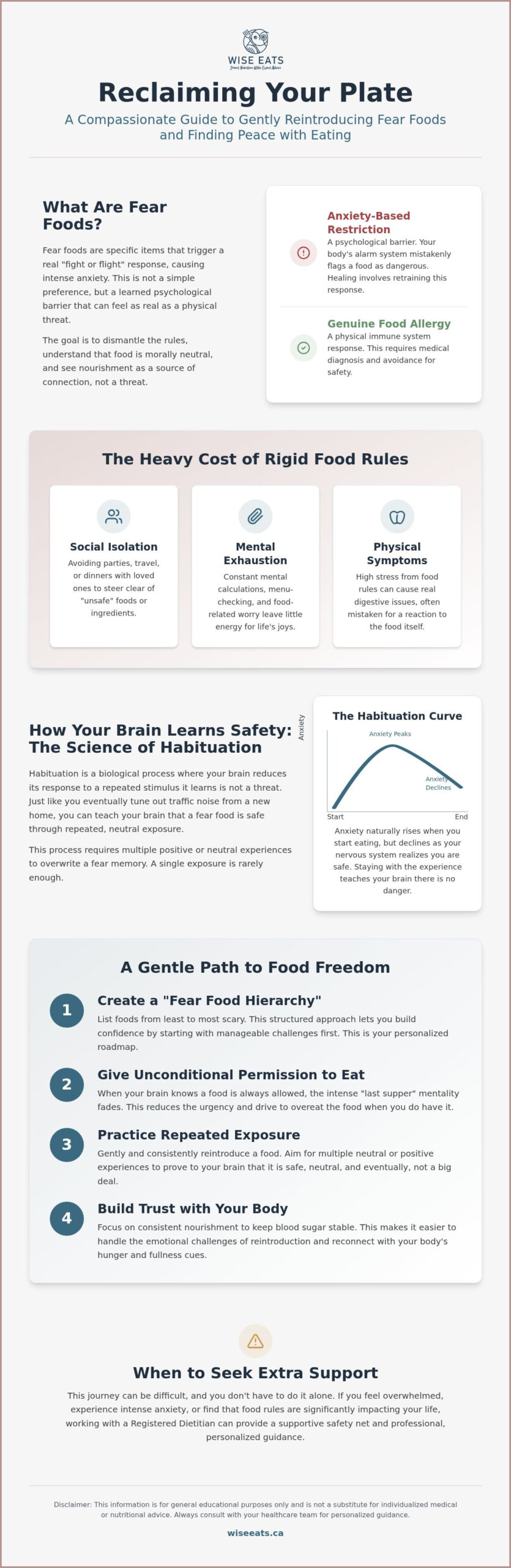
It’s helpful to realize that food is morally neutral. A slice of cake or a bowl of pasta doesn’t have the power to change your character or define your health in a single sitting. Unlike a genuine food allergy, which is a physical immune response, an anxiety-based restriction is a psychological barrier. Both feel very real, but the path to healing involves learning how to introduce fear foods back into your diet with patience. By dismantling these rules, you can begin to see nourishment as a source of connection rather than a source of threat.
Why Your Brain Labels Certain Foods as ‘Dangerous’
Your brain has a specialized alarm system called the amygdala. Its job is to keep you safe. Sometimes, it incorrectly associates a specific food with a negative outcome, like a past illness or a stressful comment from a peer. Diet culture adds fuel to this fire by using labels that suggest eating certain things is a moral failure. Even if your favourite snack is physically safe, your fear is valid because your nervous system is genuinely trying to protect you. Retraining this response takes time and a gentle, consistent approach.
The Impact of Food Rules on Your Daily Life
Living with rigid food rules carries a heavy mental load. This “background noise” is exhausting and often leads to several challenges that impact your well-being:
- Social isolation: You might skip birthday parties, dinners, or travel to avoid “unsafe” situations or ingredients.
- Mental exhaustion: The constant need to calculate ingredients or check menus in advance leaves little room for other thoughts.
- Physical symptoms: High stress levels and anxiety can lead to bloating or digestive discomfort. This sometimes makes people believe the food itself is the problem when it’s actually the body’s reaction to the stress of the rule.
Understanding how to introduce fear foods back into your diet is the first step toward reclaiming your social life and physical comfort. It allows you to focus on the people you love rather than the plate in front of you.
The Science of Habituation: How Your Brain Learns Safety
Healing isn’t just about changing your mind. It’s about retraining your biology. Habituation is the biological process of reducing a response to a repeated stimulus. Think of it like moving into a house near a busy street. At first, every car that passes is a distraction. After a few weeks, your brain decides the noise isn’t a threat and stops alerting you. This same principle applies to food. When you learn how to introduce fear foods back into your diet, you’re teaching your brain that these items are actually safe, neutral, and eventually, even a bit boring.
Many people try a “one-and-done” approach, where they eat a challenging food once and then stop. This rarely works for long-term healing because the brain needs proof of safety over and over again. We often recommend using a “Fear Hierarchy.” This is a structured tool where you organize foods from “least scary” to “most scary.” By starting small, you build the confidence needed to tackle the bigger challenges later on. It’s also vital to give yourself unconditional permission to eat. When you know a food is always available, the “last supper” mentality disappears, and the intense drive to overeat that food often fades away.
Repeated Exposure and the Neutralization of Fear
Your brain requires multiple positive or neutral experiences with a food to overwrite a fear memory. During a meal, you might experience the “Habituation Curve.” This is where anxiety peaks shortly after you start eating but naturally declines as you stay with the experience. If you leave the table while your anxiety is at its highest, your brain remembers the food as dangerous. Staying through the discomfort allows your nervous system to realize that nothing bad happened. Over time, that spike in anxiety gets smaller and smaller until the food no longer triggers a stress response.
Building Trust with Your Body
Moving away from external rules, like calorie counting or specific meal times, allows you to reconnect with your internal cues. Consistent nourishment is the foundation of this trust. When you eat regularly, your blood sugar remains stable. This stability makes it much easier to handle the emotional load of reintroducing new foods. If you’re feeling overwhelmed, working with an Eating Disorder Recovery Dietitian can provide the professional guidance you need to navigate these steps safely. You don’t have to do this alone; you can book a consultation to start building your personalized safety net today.
A Step-by-Step Guide to Introducing Fear Foods Back into Your Diet
Now that you understand the science behind your anxiety, it’s time to build a practical map for your journey. The first step in learning how to introduce fear foods back into your diet is creating a “Challenge List.” Take a piece of paper and write down every food that currently feels “unsafe” or off-limits. Next, rank them on a scale from 1 to 10. A “1” might be a food that causes only a tiny bit of hesitation, while a “10” feels completely impossible to face right now. This list helps you see that not all challenges are created equal.
For your first exposure, we suggest selecting a food ranked around a 3 or 4. This ensures the challenge is meaningful enough to build confidence, but not so intense that it feels unmanageable. When you are ready to eat, choose an environment where you feel safe and comfortable. You might try sensory grounding techniques, like focusing on the texture of your fork or the aroma of the meal. This helps keep you in the present moment rather than spiralling into “what-if” thoughts about the future. Focus on the physical sensations of the food rather than the mental rules surrounding it.
Creating Your Food Exposure Plan
Specificity is your best friend when planning an exposure. Instead of just writing “pizza,” try being more precise, such as “one slice of cheese pizza from my favourite local shop.” This clarity reduces the number of decisions you have to make in the moment. Aim for two or three exposures of that same food within a single week to build momentum. It’s also helpful to identify a support person. This could be a friend who sits with you or someone you can call immediately after the meal for a “reality check.”
The ‘After-Meal’ Window: Managing Post-Exposure Guilt
The time immediately after eating a fear food is often when the “ED voice” is loudest. You might feel a wave of guilt or an urge to skip your next meal. Recognize these thoughts as symptoms of anxiety rather than facts. You can use self-compassion scripts to stay grounded. Tell yourself: “I ate this food to heal my relationship with eating, and I am safe.” To bridge the gap while the anxiety fades, engage in a low-stress distraction. Working on a puzzle or listening to a favourite Canadian podcast can provide the mental space you need until the feelings settle.
Navigating the Journey: When to Seek Professional Support
While the steps we’ve discussed can help you start your journey, it’s okay to feel like you need a steady hand to guide you. Learning how to introduce fear foods back into your diet is a brave process, but it doesn’t have to be a solo one. A multidisciplinary team of professionals, including a therapist, a doctor, and a Registered Dietitian, can provide the structure you need to feel safe. This collaborative approach ensures that your physical and emotional needs are met at every stage of your recovery.
Working with a professional allows you to move at a pace that respects your nervous system. A dietitian can help you build a custom meal plan that acts as a safety net. This plan isn’t about rigid rules; it’s about ensuring you receive consistent nourishment while you focus on the hard work of food reintroduction. Having a plan in place can lower your anxiety because it removes the guesswork from your daily eating routine.
When to Seek Help: Identifying Red Flags
It can be difficult to know when self-guided work isn’t enough. There are several red flags that suggest you may need more structured support:
- You experience severe distress or panic that prevents you from completing a food challenge.
- You find yourself using compensatory behaviours, like skipping meals, after eating a fear food.
- You notice significant shifts in your weight or physical health markers.
- You are managing the complex overlap between IBS and disordered eating, where digestive symptoms make reintroduction feel even more confusing.
If you live in British Columbia or Alberta, seeking out a weight-inclusive practitioner can ensure you receive care that respects your body and your history with food.
Tools for Nutritional Peace of Mind
During the stressful phases of reintroduction, “pill fatigue” can become a real barrier to health. We often suggest personalized supplements from VitaminLab to help bridge nutrient gaps while you are still expanding your food variety. These all-in-one custom formulas can reduce the stress of managing multiple bottles. Because these formulas are practitioner-guided, they can be adjusted as your needs change throughout your healing. For Canadian customers, these bespoke supplements typically arrive in about 10 to 14 days, providing a seamless way to support your body’s recovery.
Always remember that recovery is not about achieving perfection or eating a “perfect” diet. It’s about reclaiming the joy of eating and the freedom to live your life without food rules holding you back. You deserve to trust your body and enjoy your favourite meals again. Every small step you take is a victory on the path to a more peaceful relationship with food.
Your Path Toward Food Freedom
Rebuilding your relationship with eating is a journey that requires both time and patience. You’ve learned that your brain can retrain its safety response through habituation and that a structured hierarchy makes the process manageable. Understanding how to introduce fear foods back into your diet is not about forcing yourself into scary situations; it’s about gently expanding your world one bite at a time. You deserve to eat without the heavy weight of anxiety or the isolation of rigid rules.
Our team of licensed Registered Dietitians in BC, Alberta, and Ontario is here to support you with weight-inclusive, HAES-aligned care. Whether you need a custom meal plan as a safety net or want to explore bespoke VitaminLab supplements to support your physical healing, we are your knowledgeable partners in this process. You don’t have to navigate these challenges alone.
Every small step you take brings you closer to a life where food is just food again. We believe in your ability to heal and reclaim the joy of eating. You are capable of this change, and we are ready to walk beside you.
Disclaimer: This article is for general educational purposes and is not a substitute for individualized medical advice. Please consult with a healthcare professional or a registered dietitian for personalized support.
Frequently Asked Questions
Is it normal to feel physically sick after eating a fear food?
Yes, it’s very common to feel physically unwell after consuming a food that causes high anxiety. When your brain perceives a food as a threat, it triggers a “fight or flight” response. This reaction can slow down your digestion and cause symptoms like nausea, bloating, or a racing heart. These sensations are often a reaction to the stress of the experience rather than the food itself.
How many times do I have to eat a food before the fear goes away?
There isn’t a magic number, but consistency is the key to habituation. Most people find that their anxiety begins to decrease after several repeated exposures. For some, a food might feel neutral after ten tries, while others may need more time. The goal of learning how to introduce fear foods back into your diet is to reach a point where the food feels “boring” rather than a source of intense emotion.
Can I introduce fear foods if I have a digestive condition like IBS?
Yes, you can absolutely work on food reintroduction while managing a digestive condition like IBS. It’s important to work with a professional who can help you distinguish between a physical sensitivity and an anxiety-led flare-up. We focus on gentle, inclusive steps that respect your gut health while slowly expanding your variety. This ensures you don’t feel overwhelmed by physical discomfort while you are working toward a more flexible way of eating.
What should I do if I feel like I’ve ‘failed’ a food challenge?
You cannot “fail” a food challenge because every attempt provides valuable information about your current comfort level. If a challenge felt too difficult, it simply means the step was a bit too big for today. Take a moment to offer yourself some compassion. You might consider trying a “Level 1 or 2” food from your list next time to rebuild your confidence. Progress isn’t linear; every small effort matters.
Do I have to eat fear foods every day to make progress?
No, you don’t need to eat these foods every single day to see progress. Aiming for two to three exposures per week is often a sustainable way to build momentum without causing burnout. This frequency helps your brain stay familiar with the food while giving you plenty of space to nourish yourself with comfortable meals in between. Consistency over several months is far more important than daily intensity.
How can a dietitian help me with fear foods specifically?
A Registered Dietitian acts as your expert guide by creating a structured plan tailored to your unique needs. We help you build your Fear Hierarchy and provide a nutritional safety net through custom meal planning. When you are learning how to introduce fear foods back into your diet, we offer the professional support needed to navigate the “after-meal” window. This ensures you’re meeting your overall nourishment goals with confidence and peace of mind.

Article by
Rachel McBryan, Dietitian
Rachel McBryan is a licenced Dietitian in British Columbia offering comprehensive nutrition counselling as virtual and/or in-person counselling sessions to suit your needs and preferences. With a Bachelor of Science in Nutrition and Food Science, Rachel has over 20 years experience helping people address their health through nutrition. She was awarded Human Nutrition and Food Science BSc.from University of Alberta followed by post-grad course work at UBC in guidance counselling.
An eating disorder is a serious mental health illness.
If you are in immediate distress or crisis, please contact emergency services by dialing 911 or calling Vancouver Island Crisis Line: 1-888-494-3888. This article is educational information only, not professional diagnosis or treatment. Content is AI generated and may not be reviewed for accuracy.