

An eating disorder is a serious mental health illness.
If you are in immediate distress or crisis, please contact emergency services by dialing 911 or calling Vancouver Island Crisis Line: 1-888-494-3888. A dietitian, psychologist, psychiatrist, and medical team work together to support eating disorder recovery.
This article is educational information only, not professional diagnosis or treatment. Content is AI generated and may not be reviewed for accuracy.
If a supplement bottle is labelled as “natural,” does that automatically mean it is safe or effective for your unique body? You might find yourself standing in the pharmacy aisle, feeling overwhelmed by rows of colourful bottles and wondering which ones are honestly worth your money. It’s completely normal to feel cautious; after all, you want to ensure what you’re putting into your system is pure and free from contaminants. Finding reliable third-party tested supplement brands Canada shouldn’t feel like a guessing game or a risk to your health.
I understand the frustration of trying to separate marketing hype from scientific reality. This guide will help you identify which products have gone through rigorous independent verification so you can find peace of mind in your daily routine. We will explore the latest 2026 Health Canada regulatory updates, explain what those NSF and USP seals actually signify, and provide a clear list of brands that prioritize transparency and quality. You deserve to feel confident that your vitamins are doing exactly what they claim to do.
This article is for general educational purposes and is not a substitute for individualized medical or nutrition advice. Please speak with a physician, nurse practitioner, pharmacist, or registered dietitian for guidance tailored to your specific needs.
Key Takeaways
- Learn how to identify the mandatory 8-digit Natural Product Number (NPN) that ensures a supplement is authorized for sale by Health Canada.
- Discover why choosing third-party tested supplement brands Canada can help you avoid contaminants and ensure you are getting the exact dosage listed on the label.
- Understand the specific roles of certification seals like NSF, USP, and ISURA in verifying the safety and quality of your daily vitamins.
- Get a simple, step-by-step checklist to audit your current supplement routine for purity, potency, and personal relevance.
- Explore how a professional supplement review may help you streamline your health strategy and ensure your choices align with your unique biology.
Understanding Third-Party Testing for Supplement Brands in Canada
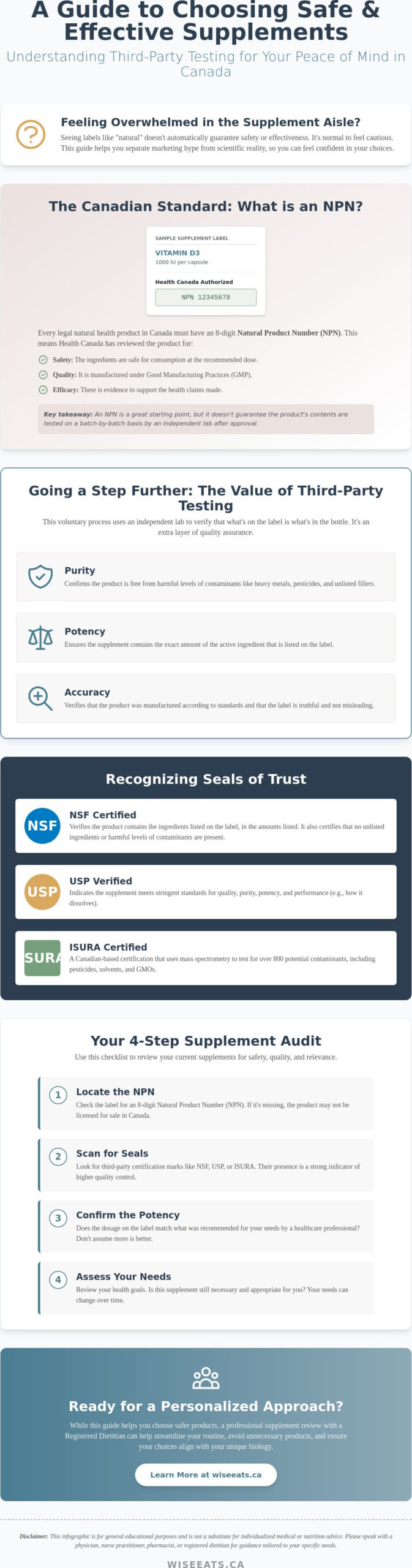
Choosing a supplement can feel like walking through a thick fog. You want to do what’s best for your health, but the labels are often confusing and crowded with claims. This is where third-party testing comes in. It is an independent laboratory verification process that checks for three vital things: purity, potency, and labelling accuracy. Essentially, an outside lab that has no financial interest in the company confirms that what you see on the bottle is exactly what you are swallowing. This extra step helps ensure your products are free from heavy metals, pesticides, or unlisted fillers that don’t belong in your body.
In Canada, every natural health product needs a Natural Product Number (NPN). This 8-digit number means Health Canada has reviewed the product for safety and quality before it can be legally sold. It is a mandatory requirement. However, while every legal supplement has an NPN, not every company chooses to go the extra mile with independent audits. Mandatory Good Manufacturing Practices (GMP) focus on the cleanliness of the factory and the systems in place. Third-party testing goes further by testing the specific contents of the finished product. Finding third-party tested supplement brands Canada ensures you are investing in products that actually contain what they promise.
To better understand why these independent checks matter for your safety, watch this helpful video:
The Role of Health Canada vs. Independent Labs
Health Canada acts as a protective gatekeeper. They review the “recipe” and the evidence behind a supplement’s claims before it reaches the store shelf. While this is a fantastic safety net, it doesn’t always account for batch-to-batch consistency over many years. This is why independent labs like NSF or USP are so helpful. They act as a steady hand, testing random samples to make sure the quality stays high long after the initial license is granted. Verifying that the label matches the contents is the only way to truly guarantee you aren’t wasting your money on ineffective vitamins. Looking for third-party tested supplement brands Canada provides that additional layer of transparency needed for clinical-grade safety.
Dietitian vs. Nutritionist: Who Should Guide Your Supplement Use?
You might wonder if you should talk to a dietitian or a nutritionist about these choices. In British Columbia, “Registered Dietitian” is a protected title under the Health Professions Act. We provide evidence-based, regulated advice that prioritizes your well-being without judgment. Exploring the science of understanding dietary supplements is much easier with a partner who understands the clinical data. If you want to learn more about how we can support your health journey, you can read about working with a dietitian to see if our supportive approach is the right fit for you.
This article is for general educational purposes and is not a substitute for individualized medical or nutrition advice. Please speak with a physician, nurse practitioner, pharmacist, or registered dietitian for guidance tailored to your specific needs.
Recognizing Certification Seals on Canadian Supplement Labels
Walking down the supplement aisle can feel like staring at a wall of confusing symbols. While Health Canada’s regulations ensure a product has been reviewed for basic safety and efficacy, those extra little logos on the back of the bottle tell a deeper story. These seals represent a brand’s voluntary commitment to transparency. When you search for third-party tested supplement brands Canada, understanding what these symbols mean can help you trade anxiety for clarity. These marks are your proof that an outside expert has verified the product’s quality.
NSF International: What It Means for the Average Canadian
NSF International is often considered the gold standard for purity. They don’t just look at the recipe; they test the actual product for unlisted ingredients and harmful contaminants like heavy metals or mould. This is especially vital for protein powders and multi-vitamins, where fillers can sometimes hide. If you’re ever unsure, you can use the NSF online database to verify if a brand is actually certified. It’s a quick way to ensure that what’s on the label is exactly what’s in your scoop. This level of detail is why many professional athletes and health-conscious Canadians look for the NSF seal first.
USP and Informed Choice: Potency and Safety
The USP (United States Pharmacopeia) Verified mark focuses on two main things: ingredient accuracy and disintegration. Have you ever worried that a vitamin pill might just pass through your system without breaking down? USP testing ensures the tablet actually dissolves so your body can absorb the nutrients. On the other hand, Informed Choice and Informed Sport focus on testing for banned substances. Unlike some audits that only happen once a year, Informed Choice often involves monthly testing of different batches. This consistent oversight provides a steady hand of reassurance for anyone concerned about long-term safety.
The Canadian ISURA Seal
For those looking for a local touch, the ISURA seal is a Canadian-specific certification. ISURA uses advanced laboratory equipment to test for over 800 potential contaminants, including pesticides and solvents. It also verifies that products are non-GMO. Seeing this seal on third-party tested supplement brands Canada means the product has met some of the most rigorous purity standards in the world. It’s a great way to support quality Canadian manufacturing while protecting your health.
Spotting Counterfeit Seals and “In-House” Testing Claims
Be cautious of logos that look official but are actually created by the brand itself. A “Quality Approved” or “Laboratory Tested” stamp designed by the manufacturer isn’t the same as an independent audit. Some companies mention a “Certificate of Analysis” (CoA), but if they don’t share which independent lab performed the test, it’s hard to verify. In-house testing is a great first step, but it shouldn’t be the final guarantee. If you’re feeling stuck on which seals to trust for your specific health goals, you can reach out to us for a supportive conversation.
This article is for general educational purposes and is not a substitute for individualized medical or nutrition advice. Please speak with a physician, nurse practitioner, pharmacist, or registered dietitian for guidance tailored to your specific needs.
Reputable Third-Party Tested Supplement Brands Available in Canada
Knowing which logos to look for is a powerful first step, but seeing those seals on a familiar label brings a genuine sense of relief. You don’t always have to visit a specialty health shop to find quality products. Several household names have made significant investments in independent verification. When searching for third-party tested supplement brands Canada, you’ll find that some of the most accessible options are also the most transparent. These companies choose to open their doors to outside auditors to prove their commitment to your safety.
Natural Factors is a standout Canadian brand that utilizes the ISURA certification we discussed earlier. They focus on intensive testing for over 800 potential contaminants. Similarly, Webber Naturals is widely available across the country and maintains rigorous quality control systems to ensure batch-to-batch consistency. Another familiar face is Jamieson Vitamins. They have introduced a TRU-ID program, which uses DNA biotechnology to verify that the herbal ingredients listed on the label are exactly what’s inside the bottle. These steps help take the guesswork out of your morning routine.
Drugstore Brands with Strong Testing Protocols
Finding verified options at your local pharmacy or grocery store is often easier than it seems. Many of these large-scale brands offer a balance of cost-effectiveness and third-party peace of mind. While supplements can be helpful, I often encourage a food-first approach when possible. You can explore nutritious Canadian-made foods to see how whole ingredients can form the foundation of your health strategy. Supplements are meant to “supplement” a balanced lifestyle, not replace it.
Professional-Grade Supplements: When Are They Necessary?
Sometimes, a standard retail brand might not meet a specific clinical need. This is where professional-line third-party tested supplement brands Canada like Thorne, Genestra, NFH, or Pure Encapsulations come into play. These companies often target specific health conditions with higher bioavailability or specialized formulations. Clinical-grade testing is often more stringent, which may be preferred if you have complex digestive issues or severe nutrient deficiencies. For example, if you suspect your ferritin levels are low despite normal blood work, working with an iron deficiency without anemia dietitian can help you identify whether a targeted iron supplement from a professional-grade brand is appropriate for your situation. These brands are typically accessed through a Registered Dietitian or other regulated healthcare providers who can help you determine if a more specialized product is appropriate for your situation.
This article is for general educational purposes and is not a substitute for individualized medical or nutrition advice. Please speak with a physician, nurse practitioner, pharmacist, or registered dietitian for guidance tailored to your specific needs.
How to Audit Your Supplements and When to Seek Professional Help
Do you have a kitchen cabinet filled with half-empty supplement bottles? It’s easy to collect vitamins over time, but a cluttered routine can sometimes do more harm than good. Taking a few minutes to audit your collection can save you money and ensure your health strategy remains safe. This process is about more than just tidying up; it’s about verifying that your choices align with your current needs. Following a simple, step-by-step approach can help you identify third-party tested supplement brands Canada that are truly worth keeping.
- Step 1: Check for the 8-digit NPN. Look at the front of the bottle for the Natural Product Number. If it isn’t there, the product hasn’t been reviewed by Health Canada for safety or quality.
- Step 2: Locate independent seals. Flip the bottle over and look for the NSF, USP, or ISURA logos we discussed earlier. These are your markers of independent verification.
- Step 3: Research brand transparency. Visit the brand’s website to see if they share their lab results. Reputable companies are often proud to show that their batches have been tested for purity.
- Step 4: Review expiry dates and storage. Check the bottom or side of the bottle for the “Best Before” date. Supplements should be kept in a cool, dry place; the humid environment of a bathroom cabinet can actually cause some vitamins to break down faster.
When to Seek Help: Clinical Safety and Complex Needs
Safety becomes even more critical if you are managing a medical condition. If you live with kidney disease or liver issues, your body may process supplements differently, which can lead to a buildup of certain nutrients. Additionally, many vitamins can interfere with prescriptions. For instance, Vitamin K can change how blood thinners work, while certain minerals may prevent antibiotics from being absorbed properly. You can read more about supplements that interact with medications to better understand these risks. Professional guidance is essential in these cases to prevent avoidable complications.
Signs You Should Re-evaluate Your Supplement Routine
Your body often provides clues when a supplement isn’t the right fit. You might notice unexpected side effects like digestive upset, skin changes, or even a metallic taste in your mouth. Another common issue is “doubling up.” If you take a multivitamin plus a specialized hair and nail formula, you may be getting overlapping ingredients that exceed the recommended daily limits. If you feel persistent fatigue, thinning hair, or restless legs that don’t improve with your current routine, it may be worth exploring whether iron deficiency without anemia could be a contributing factor, as low ferritin can cause these symptoms even when standard blood work appears normal. If you feel a desire to move toward a more “food-first” approach, it might be time to simplify your routine. Bringing your supplement bottles to a consultation is a great way to start a non-judgmental review of your needs. If you’re ready to streamline your health strategy, you can connect with us for a professional supplement audit.
The Importance of Pharmacist and Dietitian Collaboration
Your healthcare team should always have a clear picture of what you’re taking. Pharmacists and Registered Dietitians work together to ensure your supplements are safe, effective, and necessary. We can help you translate complex lab data into actionable steps that fit your lifestyle. An open dialogue with your physician also ensures that everyone is on the same page regarding your wellness goals. This collaborative approach removes the guesswork and replaces it with a steady, evidence-informed plan.
This article is for general educational purposes and is not a substitute for individualized medical or nutrition advice. Please speak with a physician, nurse practitioner, pharmacist, or registered dietitian for guidance tailored to your specific needs.
Personalizing Your Health Strategy with Professional Supplement Audits
You’ve learned how to spot the right seals and identify third-party tested supplement brands Canada, but even the highest quality product isn’t helpful if your body doesn’t actually need it. The approach at Wise Eats Registered Dietitians focuses on your unique biology rather than a generic checklist. We believe in a food-first philosophy where supplements act as a supportive bridge to fill specific, identified gaps in your nutrition. This methodical process helps ensure that every capsule you take serves a clear purpose in your wellness journey.
Think of a professional audit as a way to clear the clutter. It’s common to spend money on vitamins that might be redundant or unnecessary for your current health stage. By reviewing your intake with a Registered Dietitian, you can often save money by eliminating poor-quality products that don’t meet professional standards. We provide a steady hand to help you filter out the noise of social media trends and focus on what truly matters for your well-being. This isn’t about restriction; it’s about finding the most effective and safe path forward for your specific needs.
Moving Beyond the “One-Size-Fits-All” Multivitamin
Is your neighbour’s morning routine right for you? Probably not. Your body’s needs change based on your age, activity level, and underlying health conditions. We use clinical assessments and may review blood work results from your physician to identify actual deficiencies. Before assuming a supplement is necessary, it helps to recognize the signs of a nutrient deficiency your body may already be communicating through changes in your energy, skin, or hair. This ensures you aren’t just guessing about your health. If you want to learn more about how we tailor these choices, you can read about working with a dietitian on supplements to see how we personalize every recommendation. We act as an expert guide, helping you translate complex data into a simple, daily routine.
Your Next Steps Toward Nutritional Clarity
Ready to replace confusion with a clear, science-backed plan? The process is designed to be simple and supportive. You can start by booking a discovery call to discuss your goals and see if our partnership is a good fit for you. During a full supplement review session, we will look at your current bottles, check for potential interactions, and ensure you are using third-party tested supplement brands Canada that meet our rigorous criteria. It’s about giving you the confidence to move forward with a routine that feels right for your lifestyle. We are in this together, and our goal is to replace anxiety with a sense of hope and clarity.
This article is for general educational purposes and is not a substitute for individualized medical or nutrition advice. Please speak with a physician, nurse practitioner, pharmacist, or registered dietitian for guidance tailored to your specific needs.
Your Path to Nutritional Confidence
You now have the tools to look beyond “natural” labels and identify third-party tested supplement brands Canada that prioritize your safety. By checking for the mandatory 8-digit NPN and looking for independent seals like NSF, USP, or ISURA, you can ensure your routine is built on a foundation of purity and potency. Remember that supplements are most effective when they fill specific gaps identified through a food-first approach and professional assessment. This methodical strategy protects your health and your wallet.
Our team of BC Registered Dietitians is here to provide compassionate, non-judgmental guidance as you navigate these choices. We use evidence-based clinical nutrition to help you streamline your routine and ensure every product aligns with your unique biology. If you’re ready to replace uncertainty with a clear, science-backed strategy, you can book a supplement audit with a Registered Dietitian today. We act as your knowledgeable partner to help you filter out the noise and focus on what truly works for your body.
You deserve to feel secure in your health decisions; we’re here to support you every step of the way. Your wellness journey shouldn’t feel like a guessing game, and we’re excited to help you move forward with clarity and hope.
This article is for general educational purposes and is not a substitute for individualized medical or nutrition advice. Please speak with a physician, nurse practitioner, pharmacist, or registered dietitian for guidance tailored to your specific needs.
Frequently Asked Questions
What exactly is a third-party tested supplement?
A third-party tested supplement is a product that has been independently verified by an outside laboratory that has no financial ties to the manufacturer. These labs check for three main things: purity, potency, and labelling accuracy. This process confirms that the product is free from harmful contaminants like heavy metals and that the ingredients inside the bottle actually match what is printed on the label. It’s a vital layer of safety for your routine.
Is Health Canada registration (NPN) enough to ensure quality?
An NPN is the mandatory legal baseline for any natural health product sold in Canada. It ensures Health Canada has reviewed the product for safety and efficacy. However, choosing third-party tested supplement brands Canada provides additional voluntary oversight. While the NPN confirms the “recipe” is safe, independent testing verifies that every batch produced continues to meet those high standards long after the initial license is granted.
How can I tell if a Canadian brand is truly third-party tested?
The easiest way to verify a brand is to look for specific certification seals like NSF, USP, or ISURA on the packaging. You can also take the extra step of checking the official website of the certifying body. Most of these organizations maintain a searchable database where you can enter the brand name to confirm their certification is active. This helps you avoid “in-house” claims that haven’t been independently audited.
Are third-party tested supplements more expensive?
You don’t always have to pay a premium for quality, as many affordable retail brands invest in independent testing. Brands like Natural Factors and Webber Naturals are widely available in Canadian drugstores and maintain rigorous testing protocols. While some professional-grade lines might be more expensive due to specialized formulations, third-party verification itself is often a standard part of a reputable company’s operating costs rather than a luxury add-on.
Which Canadian supplement brands are most reputable for testing?
Reputable third-party tested supplement brands Canada include household names like Natural Factors, Webber Naturals, and Jamieson. These companies use advanced systems like ISURA and TRU-ID biotechnology to ensure their products are clean and accurately labelled. For those with more complex clinical needs, professional brands such as NFH, AOR, and Thorne are also highly regarded by healthcare providers for their stringent quality control and transparency.
Can supplements interact with my current medications?
Yes, supplements can definitely interact with your prescriptions, and sometimes these interactions can be quite serious. For example, certain minerals can prevent antibiotics from being properly absorbed; while herbal products like St. John’s Wort can change how your body processes many different medications. It’s always a good idea to share your full supplement list with your pharmacist or Registered Dietitian to ensure your routine is safe and effective.
How do I check if a supplement brand is NSF certified in Canada?
You can verify this by visiting the NSF International website and using their official “Certified Dietary Supplements” search tool. Simply type in the name of the brand or the specific product to see if it appears in their current registry. This is a great way to confirm that the seal you see on the bottle is authentic and that the product has passed their rigorous audits for purity and safety.
Do I really need supplements if I eat a balanced diet?
While a balanced diet is the best foundation for health, there are times when food alone might not be enough to meet your needs. Factors such as pregnancy, specific medical conditions, or being over the age of 50 can increase your requirements for certain nutrients like Vitamin D or B12. Understanding the signs of a nutrient deficiency can help you determine if you have a genuine nutritional gap that requires a targeted supplement or if you can meet your goals through food. A professional assessment can help you make that determination with confidence.
This article is for general educational purposes and is not a substitute for individualized medical or nutrition advice. Please speak with a physician, nurse practitioner, pharmacist, or registered dietitian for guidance tailored to your specific needs.

Article by
Rachel McBryan, Dietitian
Rachel McBryan is a licenced Dietitian in British Columbia offering comprehensive nutrition counselling as virtual and/or in-person counselling sessions to suit your needs and preferences. With a Bachelor of Science in Nutrition and Food Science, Rachel has over 20 years experience helping people address their health through nutrition. She was awarded Human Nutrition and Food Science BSc.from University of Alberta followed by post-grad course work at UBC in guidance counselling.