

What if the supplement you often associate with bulky bodybuilders is actually one of the most supportive tools for healthy aging and brain function? If you’ve felt overwhelmed by the flood of conflicting advice on your social media feed, you aren’t alone. It’s completely normal to feel cautious, especially when you hear myths about kidney health or struggle to tell the difference between the dozens of powders on the shelf. This article provides a clear, evidence-informed look at Creatine Supplementation: Safety and Efficacy – A Registered Dietitian Guide, designed to help you replace anxiety with clarity.
I know how frustrating it is to feel like you’re guessing when it comes to your well-being. You deserve a knowledgeable partner to help you filter out the hype and focus on what current research actually says. We’ll explore why creatine may offer benefits far beyond muscle growth, address common safety concerns using data from a 2025 review of 685 clinical trials, and walk through how to identify high-quality products available in Canada. This information is for educational purposes and isn’t a substitute for professional medical advice. By the end, you’ll have a practical roadmap for discussing these options with your own healthcare providers.
Key Takeaways
- Understand how creatine works as a natural energy source produced by your liver and kidneys to help power your daily movements.
- Explore emerging research suggesting that creatine may support cognitive function and healthy muscle maintenance as you age.
- Learn the evidence-informed truth about kidney health and water retention in this Creatine Supplementation: Safety and Efficacy – A Registered Dietitian Guide.
- Discover why a steady daily dose of 3 to 5 grams is often more manageable and effective for most adults than complex loading phases.
- Recognize when to seek professional guidance for a personalized supplement audit to ensure your approach fits your unique health history.
What is Creatine and How Does it Work in Your Body?
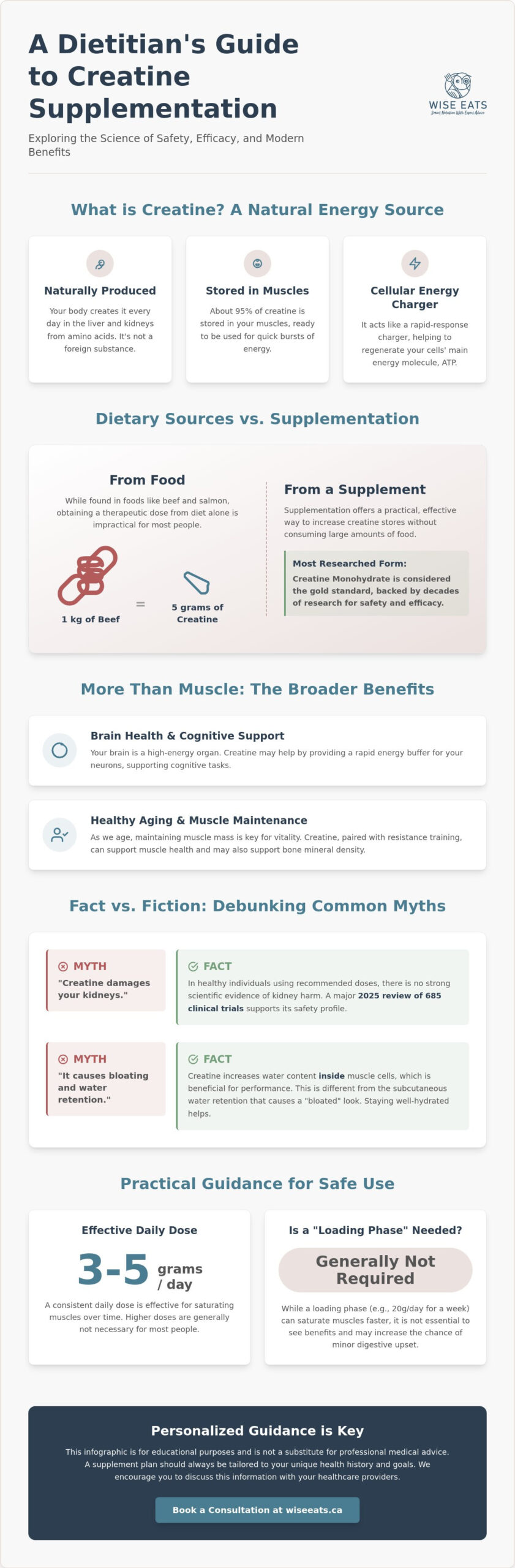
Have you ever wondered why your body produces its own creatine? Understanding What is creatine begins with recognizing that this compound isn’t a lab-made mystery. It is a natural substance your body creates every day in your liver and kidneys using amino acids. This section of our Creatine Supplementation: Safety and Efficacy – A Registered Dietitian Guide focuses on how this process supports your health from the inside out.
About 95 percent of the creatine in your body is stored in your muscles as phosphocreatine. While your internal production is steady, many people also get a portion of their intake from food. If you follow a plant-based diet, your baseline levels might be lower because natural sources are primarily animal-based. This doesn’t mean your health is at risk, but it does mean you might respond differently if you choose to supplement. Your body is an incredible machine that manages these stores constantly.
To better understand how this works within your cells, watch this helpful video:
The Role of ATP and Energy Transfer
Think of adenosine triphosphate, or ATP, as the primary battery for your cells. When you move, your body drains this battery to create energy. Creatine acts like a rapid-response charger. It provides a phosphate molecule to turn used-up energy back into functional ATP. It’s that simple. This system is most active during high-intensity, short-duration tasks. While many people think of this only for lifting weights, it also helps with a quick sprint to catch a bus or even the rapid firing of neurons in your brain. Your cells throughout your body rely on this energy transfer to function efficiently every single day.
Dietary Sources vs. Supplementation
In Canada, common dietary sources of creatine include beef, salmon, and herring. To get a therapeutic dose of about five grams, you would need to eat roughly one kilogram of raw beef. For most of us, that isn’t practical or desirable. This is why many people look toward supplements to reach their goals. Creatine monohydrate is the most researched and widely available form. It has been studied for decades, showing consistent results for those looking to support their energy stores without needing to consume massive amounts of animal protein. Choosing a high-quality product is an essential part of following a Creatine Supplementation: Safety and Efficacy – A Registered Dietitian Guide.
Beyond the Gym: The Potential Benefits of Creatine
While many people think of creatine only as a tool for elite athletes, its potential reaches far into everyday wellness and longevity. It isn’t just about the gym. Research from early 2026 suggests that this compound may play a vital role in how we maintain our physical and mental resilience as the years pass. Whether you are recovering from a minor injury or simply want to stay active in your community, understanding the broader scope of Creatine Supplementation: Safety and Efficacy – A Registered Dietitian Guide can be empowering. It is about more than just muscle; it is about supporting the systems that keep you moving and thinking clearly every day.
If you have ever been sidelined by an injury or a period of forced inactivity, you know how quickly muscle strength can fade. Some evidence indicates that creatine might assist in regaining that lost ground more efficiently once you start moving again. When paired with consistent resistance training, it may also help support bone mineral density. This is particularly relevant for those looking to protect their skeletal health over the long term. This broader perspective is a key part of any Creatine Supplementation: Safety and Efficacy – A Registered Dietitian Guide, as it shifts the focus from aesthetics to functional vitality.
Brain Health and Cognitive Support
Your brain is an energy-intensive organ. It uses a massive amount of your body’s total ATP to keep you thinking clearly. Because of this high demand, creatine can help provide a quick energy buffer for your neurons. Recent studies have looked at how this support might reduce mental fatigue, especially when you are dealing with sleep deprivation or complex tasks. While the data regarding long-term neuroprotection is still in the promising but uncertain stage, the connection between cellular energy and mental clarity is a significant area of modern research. It’s a reminder that what helps our muscles often helps our minds too.
Support for Healthy Aging
Healthy aging in a Canadian context involves a focus on maintaining functional independence. Sarcopenia, which is the age-related loss of muscle mass and strength, can make daily tasks feel more difficult over time. Evidence shows that creatine can be a helpful ally in managing this transition, especially for post-menopausal individuals looking to maintain their strength. By taking a weight-neutral approach, we can focus on how you feel and move rather than just a number on the scale. This focus on vitality allows you to continue participating in the activities you love. If you’re curious about how these benefits might fit into your life, you can connect with a member of our team to discuss your options.
Addressing Safety Concerns: Kidneys, Bloating, and Myths
It is completely understandable to feel a bit nervous when you see scary headlines about supplements. You want to make sure you’re making the right choice for your body, and that caution is a sign that you value your health. When we look at Creatine Supplementation: Safety and Efficacy – A Registered Dietitian Guide, the data is actually quite reassuring. A massive review from June 2025, which looked at 685 clinical trials, found no significant difference in side effects between people taking creatine and those taking a placebo. This suggests that for most healthy adults, it is a very well-tolerated tool.
Misinformation can often make simple facts feel complicated. You might have heard that creatine causes hair loss or severe dehydration. Current evidence does not support these claims. Most of these myths stem from small, older studies that haven’t been replicated or from misunderstandings of how the compound works. By focusing on well-established facts, we can lower the volume on that social media noise and focus on what the research actually tells us.
Creatine and Renal Health
The most common fear involves the kidneys. This confusion often comes from a blood marker called creatinine. Creatinine is a waste product that your kidneys filter out; it is also what creatine naturally breaks down into. If you take a supplement, your blood creatinine levels may rise slightly. In most cases, this doesn’t mean your kidneys are struggling. It simply means there is more “waste” to move because you’ve increased your “input.” However, if you have a history of kidney disease or pre-existing renal issues, you must consult your healthcare team before starting. We always want to ensure your specific health profile is considered.
Managing Common Side Effects
Some people do experience a bit of “bloating” when they start. It’s helpful to realize that this isn’t the same as the puffiness you might feel after a salty meal. Creatine pulls water into your muscle cells, which is called intracellular hydration. This is actually a good thing for muscle health. To help your body adjust and minimize any digestive upset, you can try these practical steps:
- Start with a smaller dose: Skipping a high-dose “loading phase” can be much easier on your stomach.
- Stay hydrated: Drinking enough water throughout the day helps the process go smoothly.
- Take it with food: Some find that having their supplement with a meal reduces any potential nausea.
Every person’s digestive system is unique. What works for a friend might not be the right fit for you. By taking a gradual, gentle approach, you can allow your body to adapt without feeling overwhelmed or uncomfortable. This information is for educational purposes and is not a substitute for an individualized assessment by a professional. For those managing digestive health concerns, a personalized plan can be a supportive path forward.
Practical Guidance: How to Use Creatine Safely
Once you feel confident about the safety profile, the next step is figuring out a routine that fits your life. It doesn’t have to be complicated. This portion of our Creatine Supplementation: Safety and Efficacy – A Registered Dietitian Guide focuses on the “how” so you can move forward with ease. Consistency is the most important factor. Whether you take it with your morning coffee or after a walk, the goal is to keep your muscle stores saturated over time. Your body is excellent at maintaining these levels once they are established.
Loading vs. Maintenance Dosing
There are two common ways to start. A loading phase involves taking about 20 grams a day for five to seven days to fill your stores quickly. While this works, it can sometimes lead to the digestive upset we discussed earlier. For most people, a steady dose of 3 to 5 grams daily is a better choice. It takes a bit longer to reach full saturation, usually about three to four weeks, but it is often much gentler on the stomach. Remember that your muscles have a limit. Taking more than the recommended amount won’t lead to better results once your stores are full. It’s about finding that sweet spot and staying there.
Choosing a Quality Supplement in Canada
Navigating the supplement aisle in Canada requires a bit of detective work. In 2025, powdered forms made up nearly 79 percent of the market because they are often the most cost-effective and pure option. Because these products aren’t regulated like prescription drugs, you want to look for specific signs of quality. First, check the label for a Natural Product Number, or NPN. This eight-digit code means Health Canada has reviewed the product for safety and quality. You should also look for third-party certifications like NSF Certified for Sport or Informed Choice. These organizations test products to ensure that what is on the label is actually in the bottle. For more help choosing the right fit for your needs, you can explore our Wise Eats supplement guide.
Your health journey is unique. While general education is a great starting point, you might still have questions about how these choices interact with your specific lifestyle or health history. If you’re ready for a personalized approach to your nutrition and supplement routine, please reach out to our team to book a consultation. We are here to help you navigate these choices with confidence and peace of mind.
When to Seek Help: The Value of a Personalized Supplement Audit
Deciding to add a new supplement to your routine is a significant step toward prioritizing your health. While general education is helpful, your body has its own unique story. A “one-size-fits-all” approach rarely provides the clarity or results you deserve because your nutritional needs are as individual as you are. This is where professional guidance becomes a navigational tool, helping you move from uncertainty to a plan that truly fits your lifestyle.
A Registered Dietitian acts as an expert guide who can translate complex data into actionable steps. We look beyond the label to see how a supplement might interact with your specific health history. This Creatine Supplementation: Safety and Efficacy – A Registered Dietitian Guide is a great starting point, but it cannot replace the nuance of a one-on-one conversation. Our goal is to replace any lingering anxiety with a sense of confidence and hope.
Signs You Need Professional Guidance
How do you know if you should pause and speak with a professional? If you are managing complex health conditions, the stakes are higher. You should seek an individualized assessment if any of the following apply to you:
- You have a history of kidney disease or other renal concerns.
- You are currently pregnant or breastfeeding.
- You are managing a chronic illness like diabetes or heart disease.
- You take multiple medications and worry about potential interactions.
- You are taking several different supplements at once.
- You have been consistent with your routine but aren’t seeing the progress you expected.
How an RD Supports Your Journey
During a personalized supplement audit, we review your health history, current medications, and your specific goals for strength or vitality. This process ensures that your choices are evidence-informed and safe. We prioritize your peace of mind by acting as a filter against misinformation. Instead of guessing which product is right, you get a clear roadmap based on clinical standards. This approach allows us to focus on what will actually support your well-being without unnecessary restriction.
If you are ready to clear the confusion and find a plan that works for your unique needs, please book a discovery call with a Registered Dietitian today. We are here to support you in making informed decisions about your health.
This article is for educational purposes and is not a substitute for professional medical advice. Always consult with your healthcare team before starting new supplements or making changes to your health routine.
Moving Forward with Confidence and Clarity
Taking the time to understand your nutrition choices is a powerful act of self-care. We’ve explored how creatine works naturally in your body and why it may offer benefits for healthy aging and brain function. You now know that for most healthy adults, the myths about kidney damage don’t hold up under clinical scrutiny. By choosing high-quality, third-party tested products in Canada and following a steady dosing routine, you can support your physical and mental resilience with peace of mind.
This Creatine Supplementation: Safety and Efficacy – A Registered Dietitian Guide provides the evidence-informed foundation you need to make an informed choice. However, your health journey is unique. Our team of BC Registered Dietitians is here to offer compassionate, non-judgmental support through personalized meal planning and supplement audits. We prioritize your well-being by filtering out the noise and focusing on practical, science-based steps. If you’re ready to create a plan that fits your specific goals, we invite you to book a personalized supplement review with a Registered Dietitian today. You deserve to feel supported and empowered every step of the way.
Frequently Asked Questions
Is creatine safe for your kidneys long-term?
Yes, current research indicates that creatine is safe for your kidneys if you are a healthy adult. Long-term studies have not shown any negative impact on renal function when taken at recommended doses. If you have a history of kidney disease, it is essential to consult your healthcare team first. This ensures that any new addition to your routine is appropriate for your specific medical needs.
Does creatine cause hair loss in men or women?
No, there is no strong scientific evidence to suggest that creatine causes hair loss. This common concern stems from a single, small study that has not been replicated in the years since. Most experts agree that hair loss is primarily linked to genetics and hormonal changes rather than this supplement. You can feel confident that current data does not support a link between the two.
Can I take creatine if I am not an athlete or weightlifter?
Absolutely, you don’t need to be a competitive athlete to see the benefits. Research from early 2026 suggests that creatine can support brain health and help maintain muscle strength as you age. It is a versatile tool for anyone looking to support their daily energy and mental clarity. This Creatine Supplementation: Safety and Efficacy – A Registered Dietitian Guide is designed for everyone, not just those in the gym.
Will creatine make me look bulky or cause weight gain?
Is it better to take creatine before or after a workout?
Consistency is much more important than the specific time of day you take it. While some research hints at a slight benefit to taking it after exercise, the most important factor is simply remembering your daily dose. Pick a time that works for your schedule, such as with breakfast or your evening meal. As long as you take it daily, your muscle stores will stay saturated.
Should I cycle off creatine or take it every day?
There is no evidence that you need to “cycle” on and off creatine to maintain its effectiveness. Your body’s stores remain full as long as you take a small maintenance dose of 3 to 5 grams every day. Stopping the supplement only causes your levels to slowly return to their original baseline. Continuous use is safe and ensures you get the most out of the potential benefits.
Can women take creatine, and are there specific benefits for them?
Yes, women can certainly benefit from using creatine at all stages of life. It can be particularly helpful for supporting bone health and maintaining muscle mass during and after menopause. This Creatine Supplementation: Safety and Efficacy – A Registered Dietitian Guide highlights how it may also assist with cognitive function and mood. It is a supportive tool for women’s overall vitality and long-term physical resilience.
What happens if I stop taking creatine supplements?
If you stop taking it, your muscle creatine levels will gradually return to their natural baseline over a few weeks. You might notice a slight decrease in muscle fullness as that extra intracellular water leaves your system. You won’t lose the muscle you’ve already built, but you may feel a small dip in your high-intensity energy during very demanding tasks. Your body will simply go back to its usual production levels.
This article is for educational purposes and is not a substitute for professional medical advice. Always consult with your healthcare team before starting new supplements or making changes to your health routine.

Article by
Rachel McBryan, Dietitian
Rachel McBryan is a licenced Dietitian in British Columbia offering comprehensive nutrition counselling as virtual and/or in-person counselling sessions to suit your needs and preferences. With a Bachelor of Science in Nutrition and Food Science, Rachel has over 20 years experience helping people address their health through nutrition. She was awarded Human Nutrition and Food Science BSc.from University of Alberta followed by post-grad course work at UBC in guidance counselling.
An eating disorder is a serious mental health illness.
If you are in immediate distress or crisis, please contact emergency services by dialing 911 or calling Vancouver Island Crisis Line: 1-888-494-3888. This article is educational information only, not professional diagnosis or treatment. Content is AI generated and may not be reviewed for accuracy.