

An eating disorder is a serious mental health illness.
If you are in immediate distress or crisis, please contact emergency services by dialing 911 or calling Vancouver Island Crisis Line: 1-888-494-3888. A dietitian, psychologist, psychiatrist, and medical team work together to support eating disorder recovery.
This article is educational information only, not professional diagnosis or treatment. Content is AI generated and may not be reviewed for accuracy.
Did you know that nearly 28 percent of Canadian adults are currently living with high blood pressure, yet less than half have their condition treated and controlled? It’s completely understandable if you feel overwhelmed by confusing nutrition labels or the hidden sodium found in common Canadian staples. You might even worry that supporting your heart means eating bland, restrictive meals for the rest of your life. We are in this together. The good news is that managing your health doesn’t have to feel like a chore.
This guide is designed to show you how the DASH diet for high blood pressure Canada can help you manage your readings using practical, evidence-based strategies tailored for your unique lifestyle. We will explore how to navigate the new 2026 front-of-package nutrition symbols, master portion sizes, and grocery shop with absolute confidence. By the end of this article, you will have a clear roadmap for meal planning that feels both sustainable and delicious. This article is for general educational purposes and is not a substitute for individualized medical or nutrition advice. Please speak with a physician, nurse practitioner, pharmacist, or registered dietitian for guidance tailored to your specific needs.
Key Takeaways
- Understand the DASH framework as a flexible, evidence-informed eating pattern designed to support heart health without feeling restrictive.
- Learn how specific minerals found in common foods like low-fat dairy and leafy greens can play a supportive role in managing your blood pressure.
- Master the “5% and 15%” rule to navigate nutrition labelling and identify lower-sodium options when following the DASH diet for high blood pressure Canada.
- Discover practical, small-step swaps such as choosing whole grains or adding a daily fruit serving to make lifestyle changes feel manageable.
- Recognize the value of professional guidance and when to connect with a Registered Dietitian to tailor these general strategies to your unique needs.
This article is for general educational purposes and is not a substitute for individualized medical or nutrition advice. Please speak with a physician, nurse practitioner, pharmacist, or registered dietitian for guidance tailored to your specific needs.
What is the DASH Diet and Why Does it Matter for Canadians?
DASH stands for Dietary Approaches to Stop Hypertension. It is an evidence-informed eating pattern rather than a rigid set of rules. Think of it as a flexible framework that helps you prioritize foods that naturally support your heart. For many of us, the word “diet” feels like a list of things we can’t have. The DASH diet is different. It focuses on what you can add to your plate to help manage your blood pressure. It emphasizes vegetables, fruit, whole grains, and lean proteins, making it a sustainable choice for the long term.
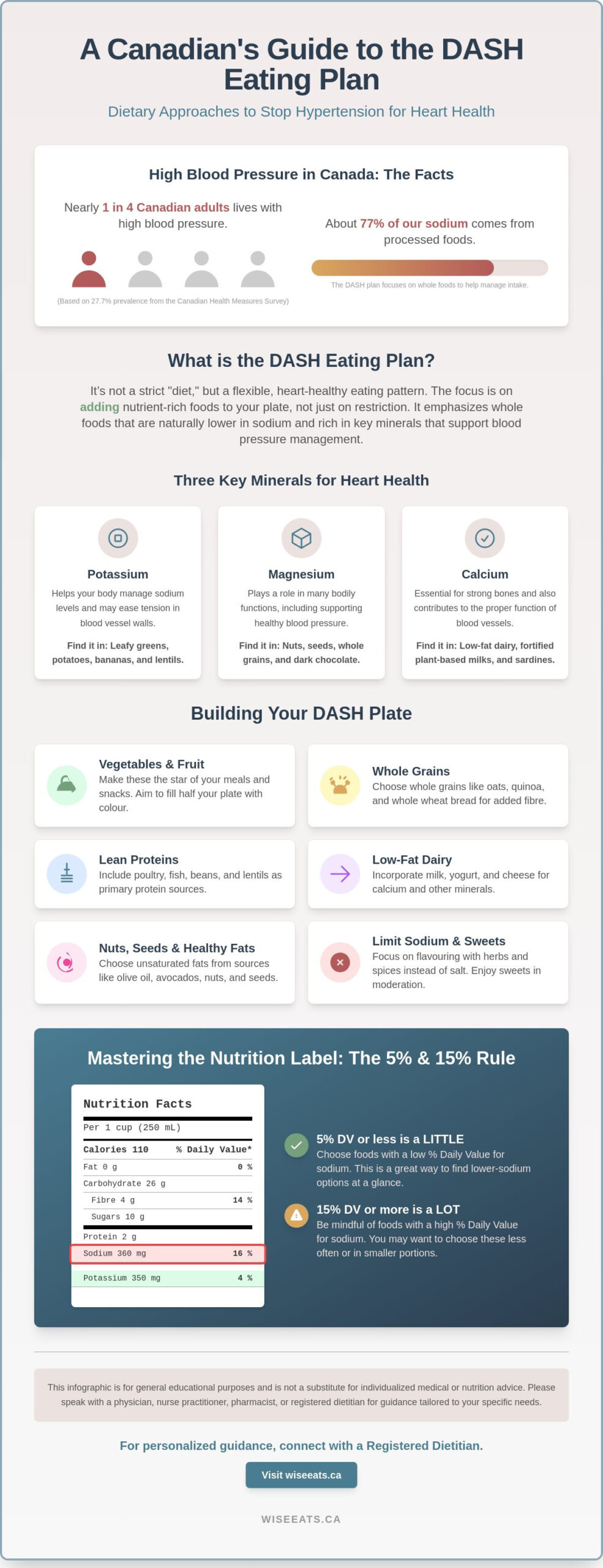
Living with high blood pressure is a reality for many people in our communities. Recent data from the Canadian Health Measures Survey shows that between 2022 and 2024, the prevalence of hypertension among Canadian adults was 27.7 percent. This means nearly one in four of us is managing this condition. Our typical eating habits often include high amounts of sodium, with processed foods accounting for about 77 percent of our daily intake. By understanding the DASH diet for high blood pressure Canada, we can begin to make small, meaningful shifts that support our cardiovascular health.
To better understand this concept, watch this helpful video:
The Science of Blood Pressure and Nutrition
The DASH pattern works by emphasizing three key minerals: potassium, magnesium, and calcium. Potassium is particularly helpful because it assists your body in excreting excess sodium and eases tension in your blood vessel walls. When these minerals work together, they help your circulatory system function more smoothly. Dietary fibre also plays a vital role. It supports cardiovascular health and can help with weight management by keeping you feeling full and satisfied. These principles align beautifully with the core recommendations found in Canada’s Food Guide, which encourages a variety of whole, nutrient-dense foods.
DASH vs. Standard Western Eating
Standard Western eating patterns often rely heavily on high-sodium processed staples. This can make it difficult to stay within recommended limits. In contrast, DASH focuses on whole foods that are naturally lower in salt. There is a common misconception that “healthy” eating must be tasteless or bland. This simply isn’t true. By using herbs, spices, and fresh ingredients, you can create vibrant meals that satisfy your palate. Research suggests that these dietary changes can have measurable effects on blood pressure readings in as little as two weeks. It’s about progress, not perfection. Small swaps can lead to significant benefits over time.
This article is for general educational purposes and is not a substitute for individualized medical or nutrition advice. Please speak with a physician, nurse practitioner, pharmacist, or registered dietitian for guidance tailored to your specific needs.
Core Principles of the DASH Eating Plan
How do we actually build a DASH-style plate? The beauty of this framework lies in its simplicity. It prioritizes whole, nutrient-dense foods while leaving room for variety. At its heart, the plan emphasizes plenty of vegetables and fruit, whole grains, and lean proteins like poultry or fish. These foods provide the foundation for a heart-healthy lifestyle. Including low-fat dairy is another key component, as it provides essential minerals like calcium and magnesium that may support healthy blood pressure levels. If you’re looking for budget-friendly staples, legumes such as beans and lentils are excellent additions. They’re packed with fibre and protein, making them a satisfying alternative to meat.
Healthy fats also play a vital role in this eating pattern. Instead of avoiding fats entirely, the focus shifts toward sources like nuts, seeds, and vegetable oils. These provide unsaturated fats that are beneficial for your cardiovascular system. Small changes add up. You don’t need to change everything at once to see a difference. By focusing on adding more of these protective foods, you can create a sustainable way of eating that feels good for your body and your budget.
Understanding Sodium Targets in Canada
Sodium is a mineral that causes the body to retain fluid, increasing blood pressure. Managing your intake is a central part of the DASH approach. The “Standard” DASH limit is set at 2,300 mg of sodium per day, which aligns with the voluntary targets set by Health Canada. For some individuals, a “Lower” limit of 1,500 mg may be recommended by their healthcare team. According to the Heart and Stroke Foundation, reducing sodium intake is one of the most effective ways to support heart health. Determining which target is right for you depends on your personal health history and current blood pressure readings.
Managing Portions Without a Scale
You don’t need a kitchen scale to follow the DASH diet for high blood pressure Canada. Visual cues can make portion management much simpler. For example, a fist-sized portion is a helpful guide for a serving of grains or vegetables. The “Plate Method” is another practical tool; aim to fill half your plate with vegetables, one-quarter with lean protein, and one-quarter with whole grains. This approach ensures you’re getting a balance of nutrients without the stress of constant tracking. If you’re feeling a bit unsure about how these general patterns fit into your specific routine, reaching out for a chat can help clarify your next steps. It’s about finding a rhythm that works for your life.
This article is for general educational purposes and is not a substitute for individualized medical or nutrition advice. Please speak with a physician, nurse practitioner, pharmacist, or registered dietitian for guidance tailored to your specific needs.
Navigating the Canadian Grocery Store: Sodium and Labels
Walking through the grocery store can sometimes feel like a puzzle. With so many claims on every box and can, how do you know what truly supports your heart? Most of the sodium in our diets doesn’t come from the salt shaker on the table. Instead, it’s tucked away in common pantry staples like bread, deli meats, and canned soups. Identifying these “hidden” sources is a major step toward making the DASH diet for high blood pressure Canada a practical part of your daily life. It’s not about being perfect. It’s about being informed.
When you’re looking for condiments or sauces, try to find “Low Sodium” or “No Salt Added” versions. Soy sauce, salad dressings, and even some spice blends can be significant sources of salt. Choosing fresh herbs, vinegars, or lemon juice to flavour your meals can help you reduce sodium without sacrificing the taste you enjoy. We want your food to be delicious, not just functional. Transitioning to lower-salt options takes a bit of time for your taste buds to adjust, but the relief of knowing you’re supporting your health is worth the shift.
Decoding Nutrition Facts Tables
The easiest way to compare two products is by looking at the % Daily Value (%DV) on the Nutrition Facts table. You don’t need to do complex math while standing in the aisle. Simply remember the 5% and 15% rule. If a serving has 5% DV or less of sodium, it’s considered “a little.” If it has 15% DV or more, it’s “a lot.” This simple tool, often highlighted in the Heart and Stroke Foundation’s guide to the DASH diet, allows you to make quick, confident decisions. Always check the serving size first to ensure it matches what you’ll actually eat.
Fresh, Frozen, and Canned: What to Choose?
Eating for your heart doesn’t have to be expensive or time-consuming. While fresh Canadian-grown produce is wonderful in the summer, frozen vegetables are just as nutritious and often a much better value in the winter months. They are usually frozen at peak ripeness, locking in those essential minerals. If you prefer the convenience of canned goods, look for “No Salt Added” varieties. A simple trick for canned beans or lentils is to give them a thorough rinse under cold water. This can reduce their sodium content by up to 40 percent. You can discover nutritious Canadian-made foods that fit perfectly into this lifestyle, ensuring your kitchen is always stocked with heart-healthy options.
This article is for general educational purposes and is not a substitute for individualized medical or nutrition advice. Please speak with a physician, nurse practitioner, pharmacist, or registered dietitian for guidance tailored to your specific needs.
Practical Steps to Integrate DASH into a Canadian Lifestyle
Sustainable change happens through small, intentional choices. You don’t need to overhaul your entire pantry by tomorrow morning. Instead, try focusing on one shift at a time. This approach makes the DASH diet for high blood pressure Canada feel like a natural part of your routine rather than an added stressor. Habits are like muscles; they get stronger the more we practice them. We are here to help you find a rhythm that feels manageable and rewarding.
- Step 1: Start with one small change. Try adding a single serving of fruit, such as a handful of BC berries, to your breakfast or as a mid-morning snack.
- Step 2: Swap refined grains for whole grains. Choosing brown rice, quinoa, or whole-wheat pasta can increase your fibre intake and help you feel satisfied for longer.
- Step 3: Move the salt shaker off the table. Relying on herbs, spices, and citrus instead of salt can significantly lower your daily sodium intake without losing flavour.
- Step 4: Fill half your plate with vegetables. Aim to reach this target at both lunch and dinner to naturally boost your intake of potassium and magnesium.
- Step 5: Plan for heart-healthy snacks. Keep unsalted nuts, seeds, or plain yogurt with berries nearby to avoid reaching for high-sodium processed snacks when hunger hits.
Flavour Without the Salt Shaker
Canadian favourites like baked salmon or roasted root vegetables don’t need salt to shine. Try a blend of dill and lemon for fish, or rosemary and garlic for roasted carrots and parsnips. Acidic ingredients like apple cider vinegar or a fresh squeeze of lime can brighten a dish’s flavour profile instantly. Sautéing onions and garlic as a base for your soups and stews adds a deep, savoury foundation that makes extra salt unnecessary. Experimenting with these aromatics can help you rediscover the natural taste of your favourite foods.
Eating Out and Social Situations
Socializing is a vital part of well-being. You can still enjoy restaurant meals while supporting your heart health. Try requesting that sauces be served on the side, or ask for your protein to be prepared without added salt. If one meal happens to be higher in sodium, you can simply balance it out with lower-sodium choices for the rest of the day. This flexibility ensures you don’t feel isolated or restricted. Our ultimate nutrition guide for meal planning offers more detailed strategies for managing your week with ease.
If you’re feeling ready to create a personalized plan that fits your unique schedule and preferences, connect with our team today to explore your next steps. This article is for general educational purposes and is not a substitute for individualized medical or nutrition advice. Please speak with a physician, nurse practitioner, pharmacist, or registered dietitian for guidance tailored to your specific needs.
When to Seek Help from a Registered Dietitian
Following the DASH diet for high blood pressure Canada provides a solid foundation, but life is rarely simple. General guidelines are a wonderful starting point. Your personal health journey might involve other factors that require a more tailored approach. Are you managing more than one health condition? Do you have specific food preferences that make standard advice feel like a poor fit? A Registered Dietitian acts as an expert guide to help you navigate these complexities. We bridge the gap between “knowing what to do” and finding a way to actually do it in your busy life.
There are certain situations where professional oversight is particularly important for your safety and well-being. If you are living with kidney disease, heart failure, or taking multiple medications for your blood pressure, general nutrition advice may not be appropriate. In these cases, specific nutrients like potassium or your total fluid intake may need careful monitoring to avoid complications. Seeking individualized support ensures that your dietary changes support your medical treatment plan without causing unintended health issues.
Personalizing the DASH Approach
Many people find that a high-fibre approach like DASH can sometimes conflict with other needs, such as managing IBS, diabetes, or specific food allergies. You might feel stuck trying to balance multiple sets of “rules.” A dietitian can help you create a custom meal plan that respects your medical needs while staying within your budget and lifestyle. By working with a dietitian, you receive a plan that is built around your life, ensuring that healthy eating feels sustainable rather than stressful.
The Value of Professional Support
Sustainable change is rarely a straight line. It is normal to feel motivated one week and overwhelmed the next. This is where behaviour-change coaching and accountability become invaluable. Professional support provides a steady hand when the path feels steep or confusing. The Wise Eats Registered Dietitians offer evidence-based, compassionate care designed to help you reach your goals with confidence. We focus on progress and small, manageable shifts rather than rigid perfection or restriction.
This article is for general educational purposes and is not a substitute for individualized medical or nutrition advice. Please consult with a physician, nurse practitioner, pharmacist, or Registered Dietitian for guidance tailored to your specific needs.
Taking Your Next Steps Toward Heart Health
You now have the tools to navigate the grocery store with confidence and build a plate that supports your well-being. Whether it’s mastering the 5% and 15% rule or swapping refined grains for whole ones, every small choice adds up. Implementing the DASH diet for high blood pressure Canada isn’t about rigid rules or giving up the foods you love; it’s about finding a sustainable balance that fits your unique lifestyle. Our Licensed Registered Dietitians provide evidence-based nutrition care through a compassionate, weight-neutral approach to help you bridge the gap between information and action.
If you feel ready to move forward with a plan tailored specifically to your needs, we are here to support you. Book a consultation with a Registered Dietitian to personalize your heart-health plan and discover how manageable these changes can truly be. This article is for general educational purposes and is not a substitute for individualized medical or nutrition advice. Please speak with a physician, nurse practitioner, pharmacist, or registered dietitian for guidance tailored to your specific needs. You’ve already taken a wonderful first step by learning more today. We are in this together.
Frequently Asked Questions
Is the DASH diet expensive to follow in Canada?
The DASH diet can be very cost-effective when you focus on versatile staples like dried beans, lentils, and frozen vegetables. While fresh produce prices vary by season and region, choosing frozen or canned options without added salt provides the same nutritional benefits at a lower price point. Buying whole grains like brown rice or oats in bulk is another practical way to keep your grocery bill manageable while supporting your heart health.
Can I follow the DASH diet if I am a vegetarian or vegan?
Absolutely, the DASH framework is easily adaptable for vegetarian and vegan lifestyles. You can simply swap animal proteins for plant-based alternatives like tofu, tempeh, chickpeas, or kidney beans. Since the plan already emphasizes fruits, vegetables, and whole grains, it aligns naturally with plant-forward eating. If you don’t consume dairy, you can choose fortified soy or nut milks to ensure you are still getting essential minerals like calcium.
How long does it take for the DASH diet to lower my blood pressure?
Research suggests that you may see a measurable decrease in your readings in as little as two weeks after starting the DASH diet for high blood pressure Canada. While individual results vary, many people notice a difference relatively quickly as their sodium intake decreases and their intake of protective minerals increases. It’s about building a sustainable rhythm rather than looking for an overnight fix. Consistently following the pattern is what leads to long-term benefits.
Do I have to give up coffee and caffeine on the DASH diet?
You don’t necessarily need to give up your morning cup of coffee while following this plan. While caffeine can cause a temporary spike in blood pressure for some people, it is not a primary focus of the DASH guidelines. If you find that caffeine makes you feel jittery or impacts your readings, you might consider switching to decaf or reducing your intake. It’s always a helpful idea to monitor how your body personally reacts to different beverages.
What is the difference between the DASH diet and a low-sodium diet?
The main difference is that DASH is a comprehensive eating pattern, whereas a low-sodium diet focuses solely on salt intake. While reducing sodium is a central part of the DASH approach, it also emphasizes adding protective nutrients like potassium, magnesium, and fibre. This “additive” approach helps support your blood vessels in ways that simply removing salt cannot. It’s a more holistic way of looking at how food impacts your circulatory system.
Is the DASH diet safe for people with Type 2 diabetes?
In many cases, the DASH pattern is an excellent choice for individuals living with Type 2 diabetes. The emphasis on high-fibre whole grains, vegetables, and lean proteins helps support stable blood sugar levels. Because hypertension and diabetes often occur together, this eating style can help manage both conditions simultaneously. However, because everyone’s carbohydrate needs are different, it’s helpful to work with a professional to ensure the plan is balanced correctly for your specific needs.
Can I still use sea salt or Himalayan pink salt?
Unfortunately, sea salt and Himalayan pink salt are not lower in sodium than regular table salt. They contain roughly the same amount of sodium by weight, meaning they have the same impact on your blood pressure. While they may contain trace amounts of other minerals, these are not significant enough to offer health benefits. To support your heart, it is recommended to rely on herbs, spices, and citrus to add flavour to your meals instead of any type of salt.
How many servings of fruits and vegetables do I really need?
For a standard 2,000-calorie plan, the goal is typically 4 to 5 servings of vegetables and 4 to 5 servings of fruit each day. This might sound like a lot if you’re not used to it, so we suggest building up gradually. A serving is generally about half a cup of cooked vegetables or one medium-sized fruit. Adding a handful of spinach to your eggs or having an apple with a few unsalted nuts as a snack can help you reach these targets easily.
This article is for general educational purposes and is not a substitute for individualized medical or nutrition advice. Please speak with a physician, nurse practitioner, pharmacist, or registered dietitian for guidance tailored to your specific needs.

Article by
Rachel McBryan, Dietitian
Rachel McBryan is a licenced Dietitian in British Columbia offering comprehensive nutrition counselling as virtual and/or in-person counselling sessions to suit your needs and preferences. With a Bachelor of Science in Nutrition and Food Science, Rachel has over 20 years experience helping people address their health through nutrition. She was awarded Human Nutrition and Food Science BSc.from University of Alberta followed by post-grad course work at UBC in guidance counselling.