

An eating disorder is a serious mental health illness.
If you are in immediate distress or crisis, please contact emergency services by dialing 911 or calling Vancouver Island Crisis Line: 1-888-494-3888. A dietitian, psychologist, psychiatrist, and medical team work together to support eating disorder recovery.
This article is educational information only, not professional diagnosis or treatment. Content is AI generated and may not be reviewed for accuracy.
Have you ever felt a pang of anxiety while eating a piece of sourdough bread or a bowl of pasta, wondering if those “acidic” foods are secretly harming your health? It’s completely understandable if you feel overwhelmed by the conflicting advice found online. Many people share that same frustration, feeling as though they must follow a rigid list of “safe” foods just to stay healthy. In this post, we will explore what an alkaline diet evidence systematic review actually tells us about how food affects our internal balance.
The good news is that your body is incredibly resilient and well-equipped to take care of itself. We’ll clear up the confusion surrounding pH levels and provide you with evidence-based strategies for long-term health that don’t involve unnecessary restriction. We are going to look at the “acid-ash” hypothesis, what the science says about bone health, and how you can centre your nutrition around nutrient-dense habits that truly support your vitality.
This article is for general educational purposes and is not a substitute for individualized medical or nutrition advice. Please speak with a physician, nurse practitioner, pharmacist, or registered dietitian for guidance tailored to your specific needs.
Key Takeaways
- Learn what an alkaline diet evidence systematic review reveals about the actual impact of “acidic” foods on your blood pH and long-term health.
- Understand how your kidneys and lungs work together to maintain a stable balance, regardless of the “ash” left behind by the foods you eat.
- Discover why cutting out certain food groups in the name of pH balance might lead to unintended nutrient gaps in your daily eating pattern.
- Explore how focusing on nutrient-dense whole foods can support your well-being without the stress of rigid, unproven dietary rules.
- Gain the clarity you need to make food choices with confidence, moving away from fear-based nutrition toward a more flexible and sustainable approach.
Understanding the Alkaline Diet: The Acid-Ash Hypothesis Explained
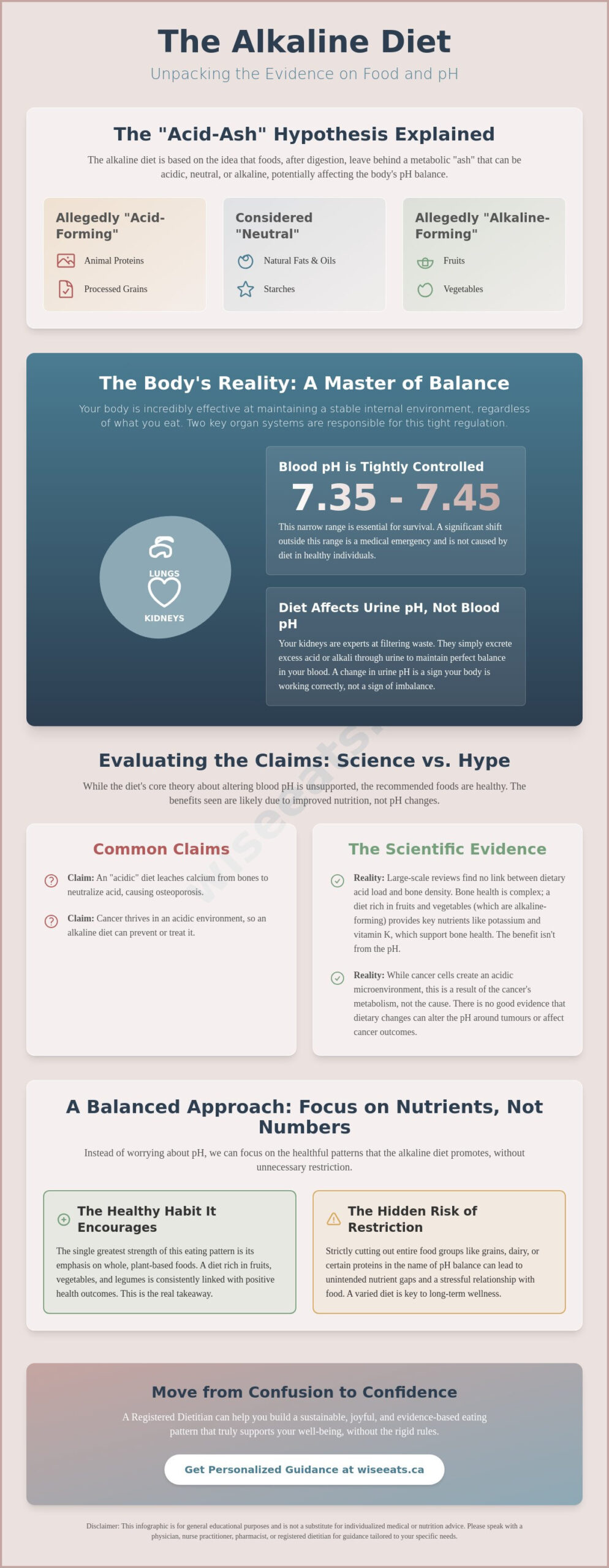
If you’ve been searching for an alkaline diet evidence systematic review, you are likely looking for clarity in a sea of confusing nutrition claims. The alkaline diet is built on the idea that the foods we eat leave behind a metabolic “ash” after they are digested. This ash is thought to be either acidic, neutral, or alkaline, depending on the mineral content of the food. If you have spent time researching this topic, you may have come across an alkaline diet overview that mentions the pH scale. This scale ranges from 0 to 14, where 7 is neutral, anything below 7 is acidic, and anything above 7 is alkaline.
Proponents of this eating pattern suggest that we should aim for a diet that results in more alkaline ash to help our bodies function optimally. To measure this, scientists use a tool called the Potential Renal Acid Load (PRAL), which estimates how much acid your kidneys need to process after you eat certain foods. It’s a complex system; it is easy to see why so many people feel overwhelmed about what belongs on their plate.
To better understand this concept, watch this helpful video:
One of the biggest sources of confusion is the difference between urine pH and blood pH. While the foods you eat can certainly change the pH of your urine, they don’t have the same effect on your blood. Your body has very strict internal controls to keep your blood pH exactly where it needs to be. If you have questions about how these biological processes affect your specific health goals, you can always ask a dietitian for more personalized guidance.
The Core Theory: Why People Believe It Works
The central belief behind this diet is that modern eating patterns, which often include more animal proteins and processed grains, are too “acid-forming.” Some claim that this internal acidity creates an environment where inflammation can thrive. While the idea of “balancing” your body sounds appealing, the real strength of the alkaline diet isn’t actually about pH. It’s because the plan encourages you to eat plenty of fruits and vegetables. This shift toward whole foods is a positive step for most people, regardless of the ash theory.
The Biology of pH Balance: How Your Body Actually Works
In reality, your body is a master of balance. Your lungs and kidneys work around the clock to keep your blood pH within a very narrow window, typically between 7.35 and 7.45. This tight control is vital for your survival. If your blood pH shifted significantly, it would be a medical emergency. When you eat “acidic” foods, your kidneys simply filter out the excess and release it through your urine. An alkaline diet evidence systematic review often confirms that while diet affects urine pH, the body’s primary systems remain stable and unaffected by the minerals in your last meal.
This article is for general educational purposes and is not a substitute for individualized medical or nutrition advice. Please speak with a physician, nurse practitioner, pharmacist, or registered dietitian for guidance tailored to your specific needs.
What Does the Science Say? A Systematic Review of the Evidence
When we look at high-quality data, the picture becomes much clearer. An alkaline diet evidence systematic review often highlights a gap between popular marketing claims and clinical reality. Much of the research in this field is observational. This means scientists look at large groups of people and their habits, but they can’t always prove that one specific thing caused a certain result. For those seeking a deeper look at these studies, this evidence-based review of the alkaline diet helps separate biological facts from common myths.
The scientific consensus is quite steady. While the foods recommended in this pattern are generally very healthy, the reason they “work” isn’t because they change your blood pH. Your body is already doing that job perfectly well on its own. We can appreciate the benefits of a plant-rich diet without needing to rely on flawed theories about metabolic ash.
The 2012 Fenton Review: Bone Health and Calcium
The 2012 Fenton systematic review is a landmark study that analyzed 55 different research papers. It specifically looked for evidence that “acidic” diets cause osteoporosis or bone loss. The researchers found no evidence to support the claim that a high-acid diet harms your bones. A common misunderstanding is that seeing calcium in your urine means your bones are “leaching” minerals to neutralize acid. However, urine calcium is not a reliable marker for bone density. In fact, protein is often labelled as “acidic” in these circles, yet we know it is essential for keeping bones strong and resilient as we age.
The 2016 BMJ Open Review: The Cancer Connection
Another major piece of research, the 2016 BMJ Open review, examined the relationship between alkaline water, diet, and cancer. The findings were clear; there is no evidence that an alkaline protocol can prevent or treat cancer. It is a common myth that cancer cannot survive in an alkaline environment. While cancer cells do create an acidic environment around themselves, the acidity is a byproduct of the cancer, not the cause of it. It is vital to prioritize conventional medical treatments and keep an open dialogue with your healthcare team. If you feel overwhelmed by these conflicting claims, you can reach out to our team to discuss how to find a balanced path forward.
This article is for general educational purposes and is not a substitute for individualized medical or nutrition advice. Please speak with a physician, nurse practitioner, pharmacist, or registered dietitian for guidance tailored to your specific needs.
Debunking Common Claims: Bone Health, Cancer, and Metabolism
It’s completely normal to feel drawn to diets that promise a “reset” or a “detox,” especially when you’re facing a health challenge or simply feeling sluggish. The idea that we can scrub our cells clean or “boost” our metabolism by changing our internal pH is an appealing story. It offers a sense of control in a world where nutrition advice feels like it’s always shifting. However, an alkaline diet evidence systematic review shows that weight loss or metabolic changes associated with this eating pattern aren’t due to pH levels at all. Instead, any positive shifts usually come from replacing ultra-processed snacks with the whole, nutrient-dense foods also found in Canada’s Food Guide.
When we compare the “Alkaline List” of foods to standard Canadian dietary guidelines, we see a lot of overlap. Both emphasize plenty of vegetables and fruits. The difference is that the alkaline diet adds a layer of unnecessary anxiety by labelling healthy foods like legumes or whole grains as “bad” or “acidic.” For a deeper dive into these findings, you can explore this NIH review on alkaline diet evidence, which examines how these claims hold up under scientific scrutiny. Realizing that you don’t need to avoid these staples can bring a lot of peace of mind to your meal planning.
Does Alkaline Water Make a Difference?
You might see expensive bottles of alkaline water promising better hydration or “detox” benefits. It’s helpful to remember how your digestion works. Your stomach is a naturally acidic environment, with a pH of about 1.5 to 2.0. This acidity is essential for breaking down food and killing harmful bacteria. When you drink alkaline water, your stomach acid neutralizes it almost immediately. While staying hydrated is a wonderful goal for your health, plain tap water is usually more than enough to do the job. You don’t need “structured” or “ionized” water to support your body’s natural processes.
Muscle Mass and Kidney Function
There is one specific area where a lower-acid diet is sometimes discussed: chronic kidney disease (CKD). In these cases, a Registered Dietitian might help a person manage their “acid load” because their kidneys aren’t able to filter waste as effectively. This is a highly specialized medical nutrition therapy. It’s very different from a general fad diet. For healthy adults, your kidneys are incredibly efficient. They are perfectly capable of handling the natural acids found in a balanced meal that includes lean protein and grains. If you are looking for a way to support your health without the stress of rigid rules, a personalized meal plan can help you focus on what your body actually needs.
This article is for general educational purposes and is not a substitute for individualized medical or nutrition advice. Please speak with a physician, nurse practitioner, pharmacist, or registered dietitian for guidance tailored to your specific needs.
The Hidden Risks of Strict Alkaline Eating Patterns
While the idea of “cleansing” your body through food sounds wonderful, the reality of strict restriction can be quite different. When we start to view common kitchen staples through a lens of fear, our relationship with food begins to shift from nourishment to navigation. An alkaline diet evidence systematic review often points out a major concern: the avoidance of healthy “acidic” foods. By cutting out legumes, whole grains, and lean proteins, you might unintentionally create significant gaps in your nutrition. These foods are not just fuel; they are the primary sources of essential minerals and vitamins your body needs to thrive.
Relying on a rigid list of “safe” foods can lead to deficiencies in Vitamin B12, Iron, and Zinc. These nutrients are vital for your energy levels, immune function, and brain health. It is much harder to meet your needs when large groups of nutrient-dense foods are off-limits. Understanding why diets fail long term can help explain why these restrictive patterns are so difficult to maintain and often leave people feeling worse than when they started. If you are feeling stuck in a cycle of restriction and want to find a more flexible way to eat, you can connect with us today to start a conversation about your unique needs.
Nutrient Gaps and Muscle Loss
One of the most serious risks of avoiding “acidic” proteins is the potential for muscle loss, also known as sarcopenia. This is especially important for older adults who need adequate protein to stay strong and mobile. If you are avoiding dairy or meat because of their “ash” value, you may also be missing out on Calcium and Vitamin D. While some people turn to “alkaline” supplements to fill these holes, they are rarely a perfect substitute for the complex matrix of nutrients found in whole foods. A diverse eating pattern is a valuable strategy for supporting long-term vitality.
The Emotional Burden of Restrictive Diets
The psychological toll of “food policing” is often overlooked. Labelling everyday items as “toxic” or “acidic” can create a deep sense of anxiety around the dinner table. In some cases, this preoccupation with food purity can lead to orthorexia, which is an unhealthy obsession with eating only “clean” or “perfect” foods. We believe in a weight-neutral, non-judgmental approach that focuses on how food makes you feel, rather than a list of rules. Food should be a source of joy and connection, not a source of stress. If you have ever found yourself cycling through restrictive plans and wondering why they never seem to stick, the science behind why diets fail long term offers a compassionate and evidence-based explanation rooted in biology, not willpower.
When to Seek Help
Nutrition is deeply personal, and sometimes the path to health requires a more individualized look. Please consider reaching out for professional support and an individualized assessment if you notice any of the following:
- You feel intense guilt or panic after eating a food that isn’t on your “safe” list.
- You find yourself avoiding social gatherings because you can’t control the ingredients.
- You are experiencing physical symptoms like extreme fatigue, hair loss, or frequent illness.
- You are managing a complex medical condition, such as chronic kidney disease or diabetes, and need guidance on how to safely balance your mineral intake.
- Your thoughts about food are taking up a large portion of your day and causing distress.
This article is for general educational purposes and is not a substitute for individualized medical or nutrition advice. Please speak with a physician, nurse practitioner, pharmacist, or registered dietitian for guidance tailored to your specific needs.
A Balanced Approach: How a Registered Dietitian Can Help You Find Clarity
After exploring what an alkaline diet evidence systematic review reveals about our internal chemistry, you might be wondering how to apply this to your daily life. It is completely normal to feel exhausted by the constant stream of nutrition “hacks” and miracle diets found online. When we look at the data, we see a much simpler truth: your body is already doing a magnificent job of keeping you in balance. My role as a Registered Dietitian is to act as your knowledgeable partner, helping you filter out the noise so you can focus on what actually moves the needle for your health. We can work together to create a plan that feels sustainable and joyful, rather than one that feels like a full-time job.
The most empowering shift you can make is moving from a mindset of subtraction to one of addition. Instead of worrying about whether a bowl of oats or a piece of salmon is “too acidic,” we look at how we can add more fibre, colour, and variety to your day. This approach lowers the stress around eating and ensures you aren’t missing out on the pleasure of a shared meal with friends or family. You deserve to feel confident in your choices without the shadow of “food policing” hanging over every bite. If you are ready to move beyond the scale and track your progress in more meaningful ways, learning how to measure nutrition success without a scale can give you a practical, weight-neutral framework for understanding how your food choices are truly supporting your health.
Personalized Supplement Audits and Meal Planning
One of the most helpful steps we can take together is a professional supplement review. Many people take “alkaline” powders or mineral drops without knowing if they truly need them or if they might interact with other medications. We also focus on custom meal planning that includes the foods you love, even if they were once labelled as “acidic” by fad protocols. By looking at actual clinical markers, such as your energy levels or digestive comfort, we get a much clearer picture of your well-being. This evidence-based approach is often more effective than any alkaline diet evidence systematic review could be on its own, as it is tailored specifically to you.
Working with a Dietitian for Chronic Conditions
For those living with specific health challenges, the stakes can feel even higher. If you are managing conditions like GERD, kidney health, or Diabetes, Medical Nutrition Therapy offers a level of precision that a general fad diet simply cannot match. You don’t have to guess which foods are right for your body. You can ask a dietitian your specific questions and receive answers that respect your unique lifestyle and preferences. You don’t have to navigate this confusing information alone. We are here to provide a steady hand and a clear path forward toward long-term health.
This article is for general educational purposes and is not a substitute for individualized medical or nutrition advice. Please speak with a physician, nurse practitioner, pharmacist, or registered dietitian for guidance tailored to your specific needs.
Embrace a Flexible Path to Wellness
Navigating nutrition shouldn’t feel like a constant battle against your own plate. As we’ve explored, an alkaline diet evidence systematic review reveals that your body’s pH balance is a tightly regulated system that doesn’t rely on restrictive “ash” theories. Real health comes from the nutrient-dense foods you add to your life, not the ones you fearfully remove. By shifting your focus from rigid pH lists to flexible, whole-food habits, you can protect your long-term vitality and peace of mind.
Our team of licensed Registered Dietitians in British Columbia and Alberta is here to help you filter through the hype. We provide an evidence-informed, weight-neutral approach that prioritizes your relationship with food. Whether you need specialized support for digestive health or managing a chronic disease, we can help you build a plan that feels right for your unique lifestyle. You don’t have to do this alone. Book a discovery call with a Registered Dietitian to find an evidence-based plan that works for you. You have the power to nourish your body without the stress of unnecessary rules.
This article is for general educational purposes and is not a substitute for individualized medical or nutrition advice. Please speak with a physician, nurse practitioner, pharmacist, or registered dietitian for guidance tailored to your specific needs.
Frequently Asked Questions
Can the alkaline diet cure or prevent cancer?
No, there is no evidence that an alkaline protocol can prevent or treat cancer. While an alkaline diet evidence systematic review might show that cancer cells thrive in acidic environments, this acidity is a byproduct of the cancer itself, not the cause. Eating alkaline foods or drinking alkaline water won’t change the pH of your cells enough to stop cancer growth. It’s essential to follow the medical guidance provided by your oncology team.
Is it true that acidic foods leach calcium from my bones?
Modern research has disproven the idea that “acidic” foods cause your body to pull calcium from your bones. Your body has a robust system to maintain blood pH without needing to dissolve your skeleton. In fact, many foods often labelled as acidic, such as legumes and lean proteins, are necessary for maintaining bone density and overall strength as you age.
Which “alkaline” foods are most beneficial to include in my diet?
Fruits, vegetables, and leafy greens are excellent choices to keep in your daily eating pattern. These foods are often categorized as alkaline because of their mineral content, but they are helpful because they provide essential fibre, potassium, and antioxidants. You can enjoy these foods as part of a varied eating pattern that also includes “acidic” staples like whole grains and protein to support your well-being.
Do I need to test my urine pH to see if my diet is working?
Testing your urine pH is not a reliable way to measure your health or the success of your nutrition plan. Your urine pH only reflects what you have recently eaten and how your kidneys are processing waste; it doesn’t provide a window into your blood pH. Focusing on your energy levels and digestive comfort is a much more helpful way to track how your food choices are supporting you. For a broader set of meaningful progress indicators, explore this guide on how to measure nutrition success without a scale, which offers a comprehensive checklist of clinical, behavioural, and functional markers.
Is alkaline water more effective for hydration than regular tap water?
Alkaline water is not superior to regular tap water for hydration or “detoxing.” Once alkaline water hits your stomach, the natural gastric acid neutralizes it almost immediately. Most Canadians have access to safe, high-quality tap water that provides all the hydration you need. You can save your money and skip the high price tag of specialized bottled products without missing any health benefits.
Can an alkaline diet help with weight loss?
An alkaline diet may lead to weight loss, but this is usually because the plan encourages more vegetables and fewer ultra-processed foods. This shift naturally increases your fibre intake and reduces calorie density. The weight loss is a result of these healthy habits, not a change in your body’s pH. You can achieve these same results with a balanced, flexible eating pattern that includes all food groups.
What is the difference between a dietitian and a nutritionist when discussing the alkaline diet?
In British Columbia and Alberta, “Registered Dietitian” is a protected title that requires specific university education and supervised clinical training. Registered Dietitians are regulated health professionals who use tools like an alkaline diet evidence systematic review to provide safe, educational guidance. While some nutritionists may have excellent training, the title is not regulated in the same way in BC, so the level of clinical expertise can vary.
Are there any medical conditions where a low-acid diet is actually recommended?
A low-acid eating pattern is sometimes used as a specific medical therapy for people with Chronic Kidney Disease (CKD). Since the kidneys are responsible for balancing acid, reducing the load can help them function more easily when they are damaged. This is a clinical intervention that should only be performed under the guidance of a physician and a Registered Dietitian to ensure you are still meeting your nutrient needs.
This article is for general educational purposes and is not a substitute for individualized medical or nutrition advice. Please speak with a physician, nurse practitioner, pharmacist, or registered dietitian for guidance tailored to your specific needs.

Article by
Rachel McBryan, Dietitian
Rachel McBryan is a licenced Dietitian in British Columbia offering comprehensive nutrition counselling as virtual and/or in-person counselling sessions to suit your needs and preferences. With a Bachelor of Science in Nutrition and Food Science, Rachel has over 20 years experience helping people address their health through nutrition. She was awarded Human Nutrition and Food Science BSc.from University of Alberta followed by post-grad course work at UBC in guidance counselling.