
An eating disorder is a serious mental health illness.
If you are in immediate distress or crisis, please contact emergency services by dialling 911 or calling Vancouver Island Crisis Line: 1-888-494-3888. A dietitian, psychologist, psychiatrist, and medical team work together to support eating disorder recovery. This article is educational information only, not professional diagnosis or treatment. Content is AI generated and may not be reviewed for accuracy.
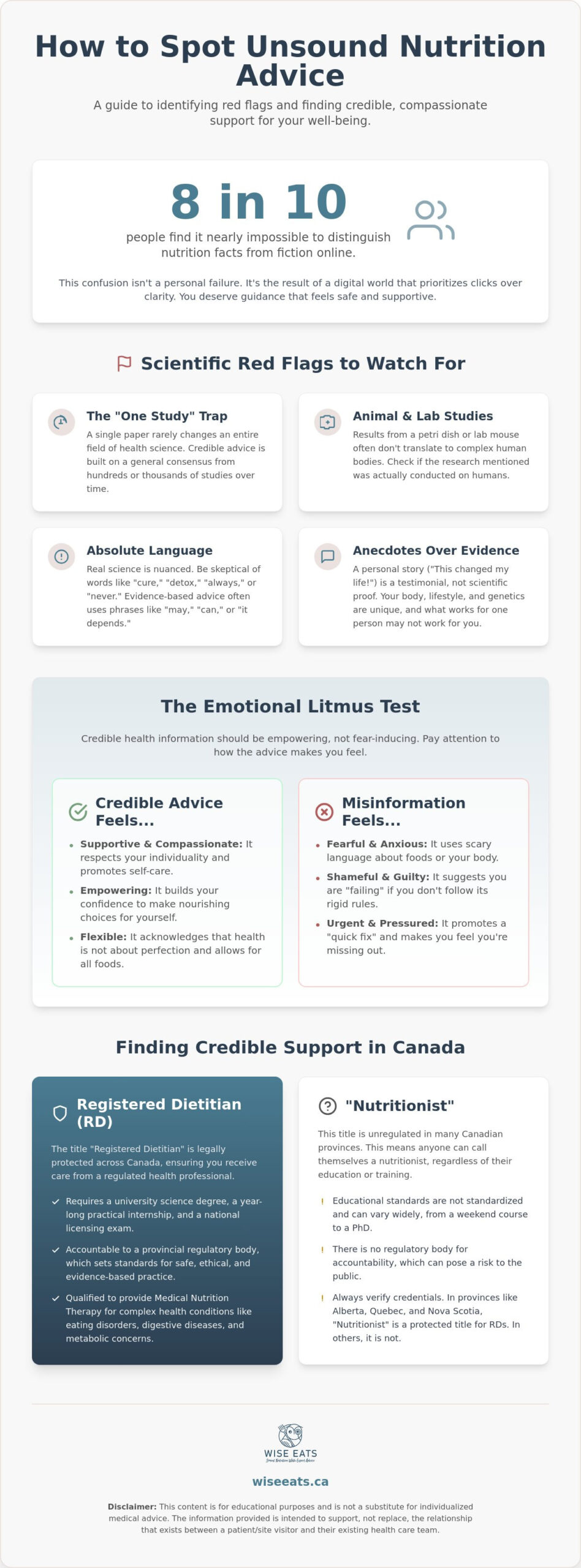
Did you know that 8 in 10 people now find it nearly impossible to distinguish nutrition facts from fiction? With nearly half of us acting on advice from social media influencers, it is easy to feel lost among the various red flags to watch for in nutrition advice today. The digital landscape has become a loud, confusing place where wellness often feels like a set of rigid rules rather than actual care. It is completely normal to feel overwhelmed by the constant stream of conflicting posts or to worry that you are failing to meet an impossible standard of health.
We are in this together, and you deserve a relationship with food that feels safe and supportive. You can learn how to filter out harmful diet culture and find evidence-based nourishment that actually supports your unique body. This guide will help you spot misinformation and provide the clarity needed to choose a qualified professional who truly understands your needs. It is time to replace anxiety with a sense of peace and confidence in your daily choices.
Key Takeaways
- Learn how to recognize scientific red flags to watch for in nutrition advice, such as the “one study” trap and the limitations of animal research.
- Identify common diet culture language that moralizes food and understand why your body’s natural systems are more effective than any “detox” trend.
- Discover how to use an “emotional litmus test” to tell if health information is truly supportive or simply designed to spark fear and shame.
- Understand the legal differences between a Dietitian and a Nutritionist in Canada to ensure you are receiving care from a regulated health professional.
Understanding the Wellness Noise: Why Nutrition Misinformation is Everywhere
Have you ever felt like you’re doing everything “right,” yet the advice you see online keeps changing? It’s not just you. Recent data from January 2026 shows that 8 in 10 people find it nearly impossible to distinguish nutrition facts from fiction. This confusion isn’t a personal failure; it’s the result of a digital environment designed for engagement, not education. One of the biggest red flags to watch for in nutrition advice is when a message is delivered by someone with a massive following but no professional credentials. We often fall for the “halo effect,” where we instinctively trust advice from people who look vibrant or successful, even if they lack the scientific training to understand human biology.
Social media algorithms prioritize clicks over clarity. Nuanced science is often quiet and slow, while sensational claims like “this common vegetable is destroying your gut” go viral because they spark fear. This often leads to a narrow focus on Understanding Nutritionism, where we stop seeing food as whole nourishment and start viewing it only as a collection of “good” or “bad” nutrients. Behind many of these viral hacks is a clear financial motivation. If a creator tells you that a specific food is “toxic,” they usually have a supplement or a “clean” alternative to sell you. They are profiting from the anxiety they create.
To better understand how to spot these patterns, watch this helpful video:
The Difference Between Anecdote and Evidence
It is tempting to listen when someone says, “This changed my life.” However, a personal story is an anecdote, not a scientific fact. What works for one person’s metabolism, lifestyle, or genetics may not work for yours. Your body is a complex, unique system. Using one person’s biological experience as a blueprint for your own can be risky. A testimonial is essentially a marketing tool designed to make you feel like you’re missing out on a “secret” that everyone else has discovered. It bypasses the rigorous testing required to ensure a recommendation is safe and effective for the general public.
Why We Are Vulnerable to Quick-Fix Claims
We want to acknowledge that it’s completely valid to seek relief. If you’re struggling with persistent bloating, fatigue, or brain fog, a “quick fix” sounds like a dream. “Hope-marketing” specifically targets people in these vulnerable states by promising immediate results with very little effort. It’s okay to feel confused or even a bit frustrated by the noise. Our goal is to help you move from a state of uncertainty toward evidence-based nourishment that respects your body’s needs without the pressure of perfection. Identifying red flags to watch for in nutrition advice is the first step toward reclaiming your peace of mind.
Scientific Red Flags to Watch for in Nutrition Advice
Science is a process, not a destination. When you see a post claiming a “groundbreaking” discovery that changes everything we know about food, proceed with caution. One of the major red flags to watch for in nutrition advice is the “One Study” trap. A single paper rarely changes an entire field of health science. True scientific understanding is built over decades through thousands of studies that reach a general consensus. If a creator mentions a study, check if it was done on humans. Results in a petri dish or a lab mouse often don’t translate to the complex beauty of the human body. Labelling a food as a “superfood” based on a study of ten people is another common tactic used to simplify complex biology.
Look for peer-reviewed citations. Credible advice usually links directly to the original research so you can see the data yourself. Be skeptical of absolute language. Words like “cure,” “always,” or “never” are rarely used by actual scientists. Real nutrition science is full of “may,” “can,” and “it depends.” Learning How to Spot Nutrition Misinformation involves looking for these subtle linguistic cues that separate evidence from hype. Evidence-based care recognizes that your body’s needs are multifactorial and cannot be reduced to a single headline.
Spotting “Junk Science” in Your Feed
Have you ever noticed how some people claim a specific food “caused” a health issue just because two things happened at once? This is the classic confusion between correlation and causation. Just because people who eat more ice cream also get more sunburns doesn’t mean ice cream causes burns; it just means it’s summer. Influencers also tend to “cherry-pick” data. They ignore 99 studies that show no effect to focus on the one outlier that supports their theory. If someone claims they have “secret knowledge” that doctors or dietitians are hiding from you, they are likely prioritizing clicks over your well-being. This “us vs. them” narrative is designed to make you feel like part of an exclusive group, but it often leads to unnecessary restriction.
The Problem with “For-Profit” Information
It’s helpful to ask: who benefits from this advice? Undisclosed sponsorships and affiliate marketing are common in the wellness space. If a person is telling you that you are deficient in a nutrient and then immediately provides a discount code for a specific brand, their advice might be biased. We believe that health decisions should be based on your unique data. Instead of following generic viral trends, you can explore personalized vitamin and mineral supplements that are tailored to your specific blood work and lifestyle. This ensures your nourishment is based on evidence rather than marketing. If you’re feeling unsure about the advice you’ve received, you can book a consultation to review your goals with a professional who prioritizes science over sensationalism.
Identifying Diet Culture Language and Fear-Based Marketing
Have you ever noticed how some health advice feels less like a guide and more like a lecture? Beyond the scientific data, some of the most common red flags to watch for in nutrition advice involve the language of shame and morality. When a creator labels food as “clean,” “dirty,” or “toxic,” they are using fear to influence your choices. Food does not have a moral value. Eating a cookie doesn’t make you a “bad” person, just as eating kale doesn’t make you “good.” This moralizing language is a hallmark of diet culture, designed to make you feel like you need to be “fixed.” Experts at Mayo Clinic Press suggest that spotting nutrition misinformation often starts with identifying these emotional triggers.
Another frequent tactic is the “detox” or “cleanse” narrative. It is a powerful marketing story, but your body already has a sophisticated detoxification system. Your liver and kidneys work around the clock to filter your blood and remove waste. No juice or tea can replace these biological powerhouses. Similarly, fear-mongering about common ingredients like seed oils, gluten, or the sugar found in fruit creates unnecessary anxiety. When advice focuses on single “superfoods” rather than your overall dietary pattern, it ignores the big picture of nourishment and joy. True health is about the patterns we build over time, not a single ingredient.
Is the Advice Weight-Inclusive or Weight-Centric?
A major red flag is any advice that assumes every person should strive for the same body size or weight. We know that health is multifactorial and body diversity is natural. When advice focuses solely on the scale, it can often lead to restrictive behaviours or a difficult relationship with food. If you are looking for a different approach, you might wonder What is a HAES Dietitian? and how they support health without the focus on weight. This weight-inclusive perspective prioritizes well-being and self-compassion over a number on a scale. It acknowledges that you can care for your body at any size.
The “Good vs. Bad” Food Binary
Rigid food rules often create a sense of social isolation. If you can’t go to a birthday party or a dinner with friends because you’re afraid of “bad” foods, the advice you’re following might be doing more harm than good. True nourishment includes food flexibility and the pleasure of eating. When we view food as morally neutral, we can make choices based on how our bodies feel and what we actually enjoy. A sustainable approach to eating is one that fits into your life, honours your culture, and supports your mental peace. You deserve to eat without a side of guilt.
The Emotional Litmus Test: How Healthy Advice Should Make You Feel
Does the advice you’re reading feel like a supportive map or a strict set of handcuffs? Credible guidance should leave you feeling empowered and capable. A major green flag is when advice respects your cultural background, your budget, and your daily reality. It should feel flexible. If a plan demands you overhaul your entire life overnight or cut out your favourite cultural dishes, it’s likely not sustainable or evidence-based. True nourishment is about adding to your life, not constantly shrinking your world.
Contrast this with the red flags to watch for in nutrition advice that rely on fear. If you feel a sudden sense of panic, shame, or the sinking feeling that you are “not enough,” that is a clear signal to step back. Healthy advice never asks you to ignore your body’s natural hunger and fullness cues. It also doesn’t use intentionally confusing jargon to sound superior. We call this the “Grade 8-10” check. If the advice is so complex that you can’t explain it simply to a friend, it might be designed to hide a lack of actual substance or to make you feel like you need a specific “expert” to survive.
When to Seek Help: Identifying Harmful Patterns
Sometimes, what starts as a simple interest in health can cross into harmful territory. It is time to pause and reach out for support if you find yourself obsessing over every ingredient label or feeling intense anxiety when a “perfect” meal isn’t available. You may also notice physical signs that your current approach isn’t supporting your biology. These can include persistent fatigue, hair loss, or feeling cold all the time. In BC and Alberta, Registered Dietitians are regulated health professionals who can help you identify these patterns. We use warm, non-judgmental language to help you navigate these struggles and find a path back to nourishment.
Building Self-Compassion into Your Nutrition Journey
Your worth is not tied to what you ate for breakfast or the number on a scale. We want to help you shift your focus toward a restored quality of life. This means being able to enjoy a birthday party or a dinner out with friends without a mental calculator running in your head. For those living with chronic digestive concerns, it is especially helpful to understand the connection between IBS and disordered eating. Recovery and health are about reconnection with yourself, not perfection. If you’re ready to move away from fear and toward a balanced approach, you can book a consultation with our team to start your journey toward peace with food.
Finding Credible Support: Why Working with a Registered Dietitian Matters
We have explored the many red flags to watch for in nutrition advice, from viral trends to fear-based marketing. Now, how do you find a partner you can actually trust? In Canada, it is vital to understand that the title “Dietitian” is a protected legal term. Unlike the word “Nutritionist,” which anyone can use regardless of their background, a Registered Dietitian (RD) is a regulated health professional. RDs must complete a university degree and a period of supervised practical training. As of 2024, all new candidates require a master’s degree to be eligible for the profession. This ensures that the person supporting you has the highest level of clinical training available.
Registered Dietitians are the only health professionals regulated to provide medical nutrition therapy. This means your care is based on rigorous scientific standards and a code of ethics that puts your safety first. An RD doesn’t give you a generic template found on a social media feed. They provide a personalized approach that considers your genetics, health history, and current relationship with food. To verify a practitioner’s credentials, you can check the public register for the College of Dietitians of British Columbia or the College of Dietitians of Alberta. This simple step ensures you are receiving care from a qualified expert.
What to Expect from a Professional Consultation
A professional consultation is a collaborative space where your voice is heard. It is not about being told what to do or being judged for your choices. Instead, it is a process of setting goals that feel manageable and supportive of your lifestyle. RDs can help manage complex conditions like diabetes or IBS without relying on restrictive dieting or “good vs. bad” food lists. You can learn more about the benefits of working with a dietitian to see how this evidence-based partnership supports your long-term well-being.
Your Next Steps Toward Clarity
Your journey toward a healthier relationship with food starts with clearing out the noise. We encourage you to “unfollow” any accounts that trigger food anxiety or make you feel like your body needs to be “fixed.” Surround yourself with information that feels flexible and compassionate. It is so important to have a care team that listens to your lived experience and respects your body’s autonomy. If you are ready to move away from the confusion of red flags to watch for in nutrition advice, you can book a discovery call with our team in Vancouver Island or Edmonton to develop a balanced, flexible approach to eating.
Disclaimer: This content is for educational purposes and is not a substitute for individualized medical advice. Please talk with your care team before making significant changes to your nutrition plan.
Reclaiming Your Relationship with Food
Identifying the red flags to watch for in nutrition advice is a major step toward reclaiming your mental peace. You now have the tools to spot the difference between a sensational “quick fix” and the nuanced, evidence-based care provided by a regulated professional. Your body is a complex, beautiful system. It deserves a personalized approach rather than a rigid set of rules. By prioritizing self-compassion and food flexibility, you can move away from the digital noise and toward a life where nourishment feels natural and supportive.
Our team of Registered Dietitians in BC and Alberta is here to act as your expert guide. We offer an evidence-based, non-diet approach and specialize in eating disorder recovery and digestive health. You don’t have to navigate this landscape alone. We can work together to build a plan that respects your unique history and supports your restored quality of life. Book a consultation with Wise Eats Registered Dietitians today to develop a balanced, flexible approach to eating. You deserve to feel confident and at ease with your food choices.
Disclaimer: This content is for educational purposes and is not a substitute for individualized medical advice.
Frequently Asked Questions
Is a nutritionist the same as a registered dietitian in Canada?
No, these titles have very different meanings depending on where you live. In British Columbia and Alberta, “Registered Dietitian” is a protected legal title that requires a university degree and master’s level training. Anyone can call themselves a “nutritionist” without any formal education or oversight. Working with a dietitian ensures you are receiving care from a regulated health professional held to high ethical standards.
How can I tell if a nutrition study I saw on the news is reliable?
Check if the research was conducted on humans or animals first. Results from a lab mouse often don’t translate to human biology. You should also look for a large sample size and peer-reviewed citations. One single study rarely changes the entire field of science; it’s the total body of evidence over many years that truly matters for your health.
What are the most common red flags in weight-loss marketing?
Watch for “before and after” photos or promises of rapid, “miracle” results. These are major red flags to watch for in nutrition advice because they simplify complex health into a single number on a scale. Marketing that uses words like “detox,” “clean,” or “guilty pleasure” is designed to spark fear or shame rather than provide actual nourishment for your unique body.
Is it a red flag if a health professional sells their own supplements?
It can be a conflict of interest. If a practitioner only recommends the specific products they sell, their advice might be biased by financial gain. A credible professional will prioritize your health needs and offer various options. They should be able to explain exactly why a supplement is needed based on your personal blood work or health history.
How do I know if my relationship with food is becoming unhealthy?
You might notice that food is taking up a lot of “brain space” or causing you distress. If you find yourself avoiding social events, obsessing over ingredient labels, or feeling like a “bad” person for what you ate, these are signs to pause. These feelings of anxiety often indicate that a diet is becoming harmful to your mental and emotional well-being.
Can I trust nutrition advice from a personal trainer or fitness coach?
Personal trainers are experts in movement, but they don’t have the clinical training to provide medical nutrition therapy. While they can offer general food encouragement, they aren’t qualified to manage health conditions or eating disorder recovery. For personalized advice that respects your medical history, it’s best to talk with a Registered Dietitian who specializes in those areas.
What should I do if a diet is making me feel tired or bloated?
Your body is sending you important signals that its needs aren’t being met. If a way of eating leaves you feeling exhausted, cold, or physically uncomfortable, it is likely too restrictive. You don’t have to push through the pain. It’s helpful to stop the restriction and talk with your care team to find a way of eating that actually supports your energy.
How do I find a weight-inclusive dietitian in British Columbia or Alberta?
Look for practitioners who use terms like “HAES” or “non-diet” in their descriptions. These professionals focus on well-being rather than the scale. You can check the public registers for the provincial colleges of dietitians to verify their credentials. Our team at Wise Eats provides this compassionate, weight-inclusive support to clients across Vancouver Island and Alberta, focusing on restored quality of life.
Article by
Rachel McBryan, Dietitian
Rachel McBryan is a licensed Dietitian in British Columbia offering comprehensive nutrition counselling as virtual and/or in-person counselling sessions to suit your needs and preferences. With a Bachelor of Science in Nutrition and Food Science, Rachel has over 20 years experience helping people address their health through nutrition. She was awarded Human Nutrition and Food Science BSc. from University of Alberta followed by post-grad course work at UBC in guidance counselling.